About Sterculia urens Roxb.
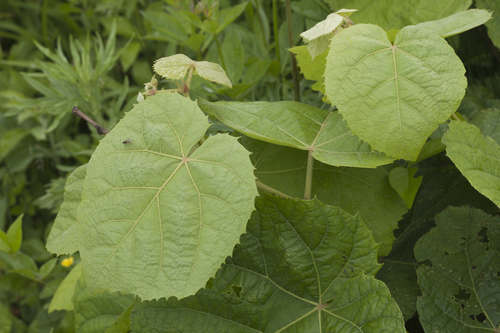
Sterculia urens Roxb., commonly known as gum karaya, is a medium-sized deciduous tree. It reaches a maximum height of around 15 meters (49 feet) and has horizontally spreading branches. Its bark is smooth, fibrous, thick, and greenish-grey, with the outer surface layer peeling off in large flakes. Young twigs are initially hairy. Its leaves are alternate, simple, hairy on their undersides, marked by three to five palmate lobes, and grow clustered at the tips of twigs.
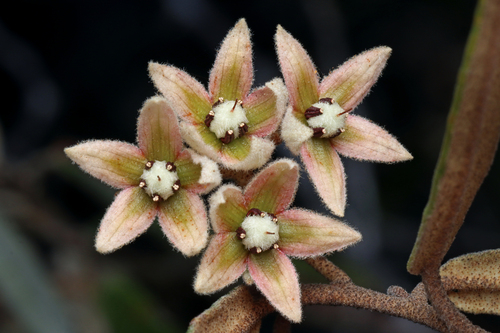
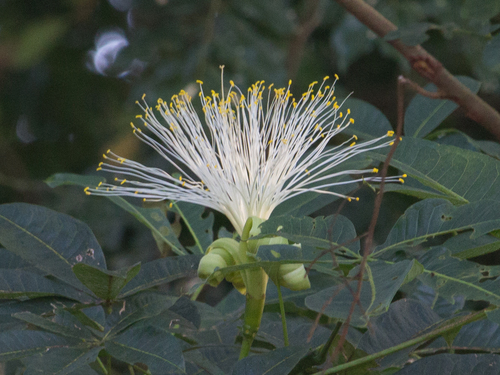
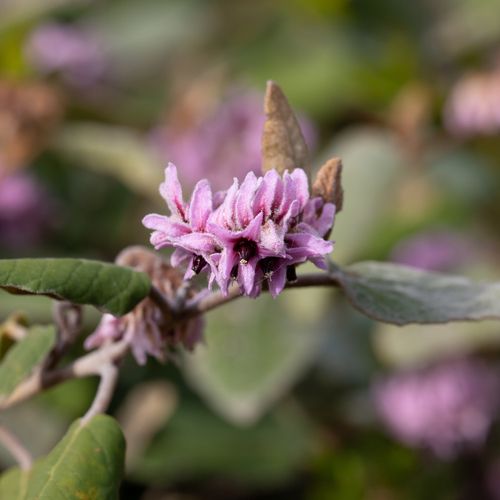
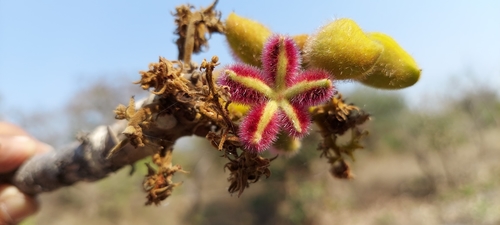
The tree's yellowish-green flowers grow in panicles in the leaf axils. It is polygamous, meaning it produces male, female, and bisexual flowers on a single individual, and all flowers are covered in short sticky or glandular hairs. Flowers have a five-lobed calyx and no petals. Male flowers have a columnar cluster of ten stamens, while bisexual flowers have a ring of anthers surrounding five free, radiating carpels. When fully developed, these carpels reach 75 millimeters (3 inches) long, are pinkish, and densely covered in red hairs, including stinging hairs. The only recorded pollinator of this species is Apis indica, and wind does not contribute to its pollination. When its fruits ripen, they split open to reveal up to six squarish brown or black seeds.
Gum karaya is native to the Indian subcontinent, Indo-China, and Malesia. It is a common species that grows in both wet and dry deciduous forests, and is often found on steep, rock-strewn slopes at altitudes between 400 and 800 meters (1,300 and 2,600 feet).
When the bark of this tree is damaged, it exudes a natural gum called gum karaya, which is a commercially valuable substance. Traditionally, the gum is tapped by cutting or peeling back the bark, or making deep gashes into the base of the trunk with an axe; these crude extraction methods often kill the tree. Researchers have found that applying the plant growth regulator ethephon stimulates gum production, and when used in carefully controlled amounts, it increases gum yield and improves wound healing, helping the tree survive.
Karaya gum absorbs water and swells, and is used as a laxative because the added bulk stimulates the intestine to expel waste. Karaya gum has been claimed to have aphrodisiacal properties, but there is not enough evidence to support this claim. Other uses for the gum include acting as a thickener in cosmetics and medications, and as an adhesive for dentures. In manufacturing, it is added as a binder, emulsifier, and stabilizer to beverages and foods. The tree's seeds are also roasted and eaten by people.