About Sterculia africana (Lour.) Fiori
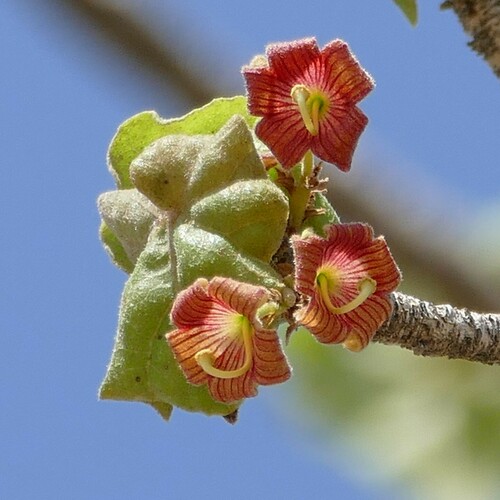
Sterculia africana (Lour.) Fiori is a deciduous monoecious tree that reaches up to 8 meters in height, with a single trunk and a rounded crown. Its bark is smooth, flaking, and colored grey or pinkish brown. Its leaves grow alternately, are crowded at the ends of branches, and are orbicular in shape, measuring 8–15 cm long by 8–15 cm across. The leaves are 3-5 lobed and covered in stellate hairs. Flowers emerge before the leaves develop, are 1.5–2 cm across, and grow in axillary panicles. Flowers are unisexual, with both sexes present on the same individual tree. They have no petals, but the colored calyx functions like a corolla. In male flowers, the numerous anthers are fused together into a column. The fruits are made up of 3-5 spreading, ovoid lobes that split when mature; the lobes are covered in dense golden hairs, and their inner surface has small stinging hairs. This species sheds its leaves during the dry season and flowers before new leaves emerge at the start of the monsoon. Small amounts of resin ooze from the bark of the trunk and larger branches. Sterculia africana has been recorded in southeastern Egypt, Eastern Sudan, Ethiopia, Djibouti, northern Somalia, southern Tanzania, Mozambique, Malawi, eastern Zambia, Zimbabwe, Botswana, and Namibia's Caprivi Strip. No subspecies are listed in the Catalogue of Life, though the variety socotrana is endemic to the island of Socotra. It grows in dry woodlands on limestone escarpments and wadi sides, usually at elevations below 600m. Traditionally in Arabia, resin from this tree was used as a washing agent: hardened resin was mixed with water or saliva and rubbed over the body. The resin was also used as a treatment for head lice. Sterculia africana is an important fodder, and its wood is used to make fishing platforms.