About Stercorarius maccormicki H.Saunders, 1893
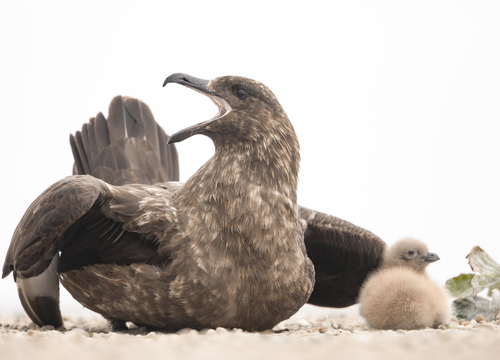
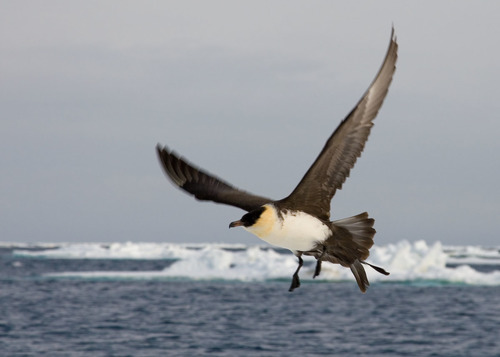
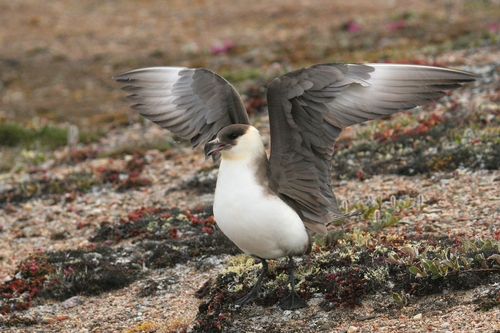
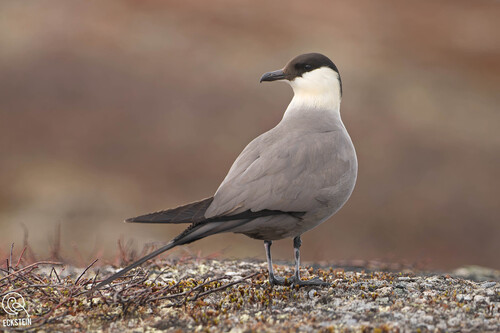
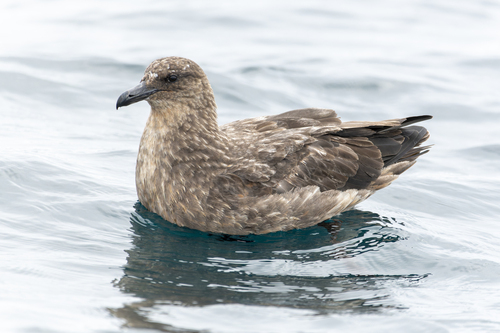
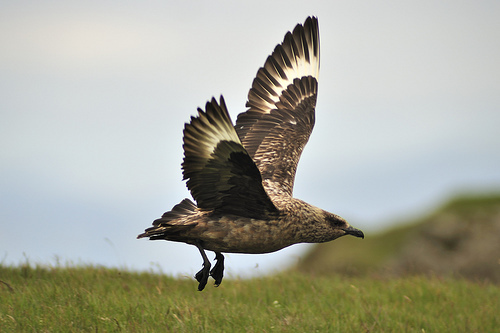
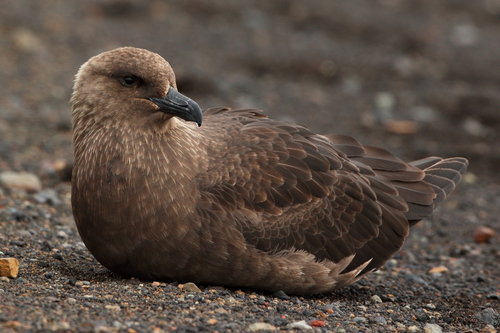
The south polar skua, with the scientific name Stercorarius maccormicki H.Saunders, 1893, is a large bird, though it is smaller than other skuas sometimes placed in the genus Catharacta. It measures roughly 53 cm (21 inches) in length. Adult south polar skuas are greyish brown on their upper bodies; pale morph adults have whitish heads and underparts, while intermediate morphs have straw-brown heads and underparts. The contrast between the head and body allows easy separation from similar species when seen clearly. Juveniles and dark morph adults are harder to tell apart from related species, requiring more subjective or difficult-to-observe identification criteria, such as colder brown plumage and a blue bill base. Distinguishing the south polar skua from the Northern Hemisphere Arctic skua, pomarine skua, and long-tailed skua is relatively straightforward. Even at a distance, this species' large size, massive barrel chest, and white wing flashes are distinctive. It has a direct, powerful flight. Identification becomes more complicated when the south polar skua needs to be separated from the closely related great skua of the North Atlantic, and other large Southern Hemisphere skuas. These identification issues mean that claims of any Southern Hemisphere skua sighting in the eastern North Atlantic are questionable, and few records of south polar skua have been accepted in Western Europe. Similar issues also occur with extralimital sighting claims for great skua. This species breeds on Antarctic coasts, usually laying two eggs during November and December. It is a migratory species that winters at sea in the Pacific, Indian, and Atlantic Oceans. In the eastern North Atlantic, it is replaced by the closely related great skua (S. skua). South polar skuas have been observed at the Geographic South Pole itself. Megalestris Hill on Petermann Island, located in Antarctica's Wilhelm Archipelago, is named after an obsolete generic name for the south polar skua.