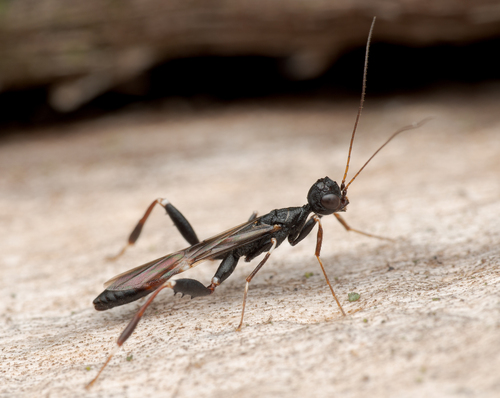
About Stephanus serrator (Fabricius, 1798)
Stephanus serrator is a species of stephanid wasp, commonly called crown wasps. This common name comes from the group of five tubercles located on the top of the wasp's head. This species has a somewhat elongated prothorax connected to the propodeum (the first abdominal segment) by a very long petiole, and the ventral side of its hind femur bears teeth. Male S. serrator average 9.5 mm (0.37 in) in length, while females average 13 mm (0.51 in) in length, with an ovipositor measuring 11.4 mm (0.45 in). Its slender body and legs are mostly black, with the exception of the front half of the abdomen and certain leg segments, which are red. S. serrator has been recorded in Spain, France, the Netherlands, Italy, Germany, Switzerland, Austria, the Czech Republic, Hungary, Romania, Bulgaria, Croatia, Serbia, and Montenegro. Adult wasps can be found on and around trees that have been dead for approximately one year, which contain beetle larvae but have not yet been invaded by fungi. The wasp has been recorded parasitizing several different host species. It is usually found in forests or other rural locations. However, when it was first recorded from Romania in 2015, the wasps were found on a timber shed in an urban environment. Other non-natural habitats where it has been observed include fencing, utility poles, wooden boarding, and stacked firewood; in each of these cases, the wasps are attracted by beetle larvae living within the wood. S. serrator is a parasitoid that targets the larvae of wood-boring beetles. Although the wasps are capable of flight, they usually move by walking and typically avoid sunlight. Spiders including Nuctenea umbratica and Parasteatoda species sometimes feed on these wasps, though the wasps usually manage to evade these predators. When female wasps search for beetle larvae inside wood, they use a characteristic posture: fore and hind legs spread widely, middle legs folded tightly against the body, antennae lowered, and the ovipositor sheath pressed against the wood. After holding this posture, the wasp moves a few centimeters to a new location and repeats the process. Once a potential target is located, the female bores her ovipositor into the wood substrate. Boring can take many hours, with females resting between efforts by withdrawing their ovipositors. They appear to be able to re-locate the original bore hole when they resume boring. As the ovipositor is pushed deeper into the wood, the ovipositor sheath arches upward into a loop. Females lay their eggs in the galleries created by host beetle larvae. Developing wasp larvae feed on the beetle larvae, and do not consume the most heavily chitinised parts. When fully developed, the wasp larvae pupate inside the empty galleries left by the beetle larvae. Adult male wasps emerge around ten days before females, and adopt a search posture similar to that of searching females, likely while waiting for females to emerge.

