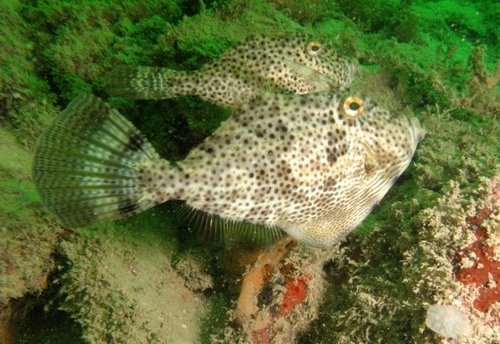
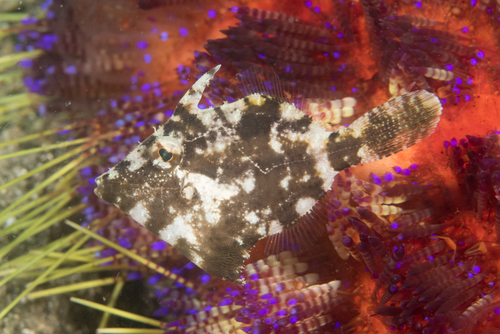
About Stephanolepis hispidus (Linnaeus, 1766)
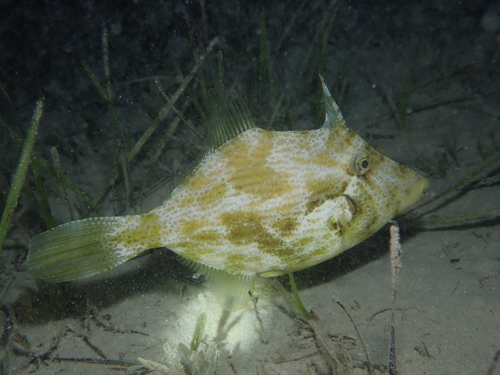
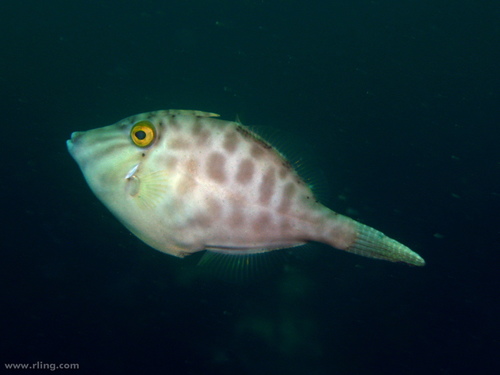
Planehead filefish, scientifically Stephanolepis hispidus (Linnaeus, 1766), grow to a maximum length of 27 cm (11 in), with a more typical length of around 17 cm (6.7 in). Their colouration is cryptic, with mottled pale brown, olive, or green tones over a light-coloured background, and they sometimes have darker brown splotches and streaks. This species has laterally compressed, deep bodies, with an elongated snout and a terminal mouth. Their large yellow eyes are positioned high on the head, and a prominent retractable spine sits above the eyes; this is the anterior of two spines connected to the long dorsal fin, which also holds 29 to 35 soft rays. The anal fin has no spines and contains between 30 and 35 soft rays. The pectoral fins are small, while the tail fin is large and fan-shaped, and often marked with two darker-coloured bands. Planehead filefish are sexually dimorphic. In mature males, the second soft ray of the dorsal fin becomes greatly elongated, reaching between 104 and 128 mm, and scales on either side of the caudal peduncle develop into a patch of bristles. Females do not develop these secondary sexual characteristics. Females also tend to have a greater body depth than males, though this trait varies in both sexes and overlapping measurements have been recorded. The planehead filefish occurs in the Atlantic Ocean at depths reaching up to 300 m (980 ft). Its range extends from Nova Scotia to Uruguay in the western Atlantic, and from the Canary Islands to Angola in the eastern Atlantic. It lives near the seabed on reefs, and over sandy and muddy sea floors, and is often found among Sargassum seaweed. This species is edible for human consumption. In the Canary Islands, it is caught in fish traps. It was once considered an incidental by-catch caught alongside other more desirable fish, but it has been a targeted commercial species since the 1980s. By 2000, concerns about overfishing of this species had emerged.