About Stenoria analis Schaum, 1859
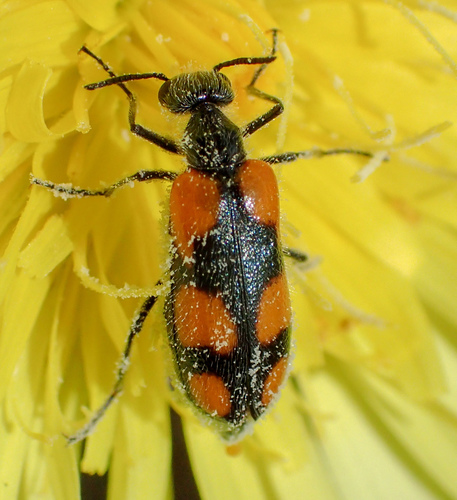
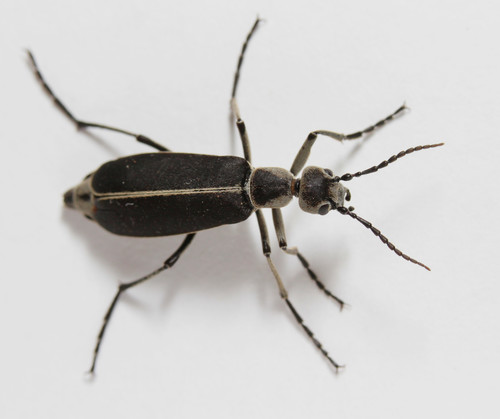
Stenoria analis is a small black and buff-colored beetle. These beetles fly swiftly on sunny days, in a flight pattern that resembles that of bees and wasps. Its distribution ranges from southern Europe and North Africa, north to southern Germany and the Channel Island of Jersey, and east to Silesia in northern Poland, and southern Russia and Anatolia in the south. In western Europe, the only known host for S. analis was Colletes hederae, which is not found in regions like North Africa or Anatolia, so it was suggested that other hosts besides Colletes hederae exist for this species. Larvae have been recorded on males of Colletes succintus in France. As Colletes hederae spreads northward through western Europe, S. analis has followed it, and has been recorded in new areas of Germany. It is expected to eventually colonize southern Great Britain, where the ivy bee (Colletes hederae) has successfully established itself since 2001. After mating, which has been observed occurring in low vegetation, female Stenoria analis lay their eggs on plants near aggregations of ivy bees. Females lay clutches containing at least 117 eggs. As the eggs develop, internal changes are easily visible, and these changes grow more obvious as larval hatching approaches. In Germany, hatching takes place at the end of summer, between 15 and 24 days after eggs are laid. Newly hatched larvae are small and have three claws, so they are called triungulins. Patrolling male ivy bees are attracted to groups of triungulins, and hover in front of the larval aggregations in the same way they approach newly emerged female ivy bees. Males attempt copulation, a behavior called pseudocopulation, with the clusters of triungulins, which allows small groups of larvae to move onto the male bee's thorax. Larger groups of triungulins are only ever found on the thorax of male bees, leading to the proposal that S. analis triungulins mimic the female pheromones of their host species. Initially, larvae form a disorganized clump, but after one day, the clump rearranges so that the brown heads of the larvae point outward, and the larvae become very active. When gently brushed against a brush, some larvae will cling to the brush's hairs, just as they cling to a host bee, using their feet, which each have one curved claw and two curved bristles. This larval stage also has strong jaws, which larvae use when they are attached to a host via their feet and cannot use their claws. Male ivy bees normally hatch before females, and typically stay a few centimeters above the ground close to the nesting aggregation where they search for females. Males react very strongly once a female bee is detected. To transfer to a host bee, triungulins need to draw the bee close. Since pheromones are important for sex recognition in bees, it is possible that this blister beetle's triungulins can chemically mimic bee pheromones to attract their hosts. This chemical mimicry may be combined with optical mimicry: a cluster of larvae with brown heads facing outward may resemble a female bee, and this impression may be strengthened by the larvae's movement, which can imitate the movement of a female bee for males. After males mate with newly emerged female bees, the triungulins transfer onto the mated females, who carry the larvae back to their nest chambers. The beetle larvae then attach themselves to the cell wall, and allow themselves to be sealed inside the cell. It is thought that they behave like other blister beetles: they first consume the host bee's egg, then feed on the pollen provision the female bee left for the bee grub. The consistency of the provisioned pollen and nectar matters for the larvae: if it is too liquid, larvae may drown, and if it is too thick, larvae may starve. S. analis prefers nests of bees in the genus Colletes, but has also been found in nests of bees in the genus Andrena. Only one triungulin develops per host cell; if two triungulins are in the same cell, one will kill the other. A few days later, the triungulin metamorphoses into a secondary larva, developing a soft, thick body that allows it to float on the provisioned material while feeding. It continues growing, and after two instars, it becomes an obese, large white grub. It continues feeding until late April, when it becomes a pseudonymph after a final molt. It stops feeding, and remains immobile inside the shed cuticles (exuvia) of previous instars. This instar is distinct from earlier ones because it shows visible signs of developing adult organs. The nymph is initially white, then slowly darkens, and emerges as an adult imago around 10 days after the final molt. The new imago stays immobile for a few days, then tears through the surrounding membranes, exits the cell, and emerges into the open the following summer.