About Stenorhynchus seticornis (Herbst, 1788)
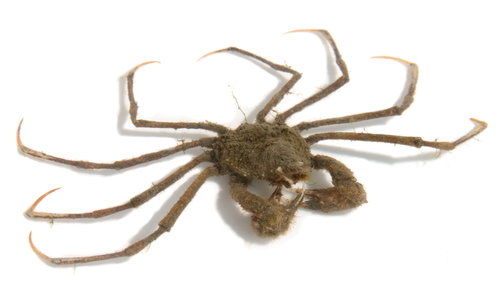
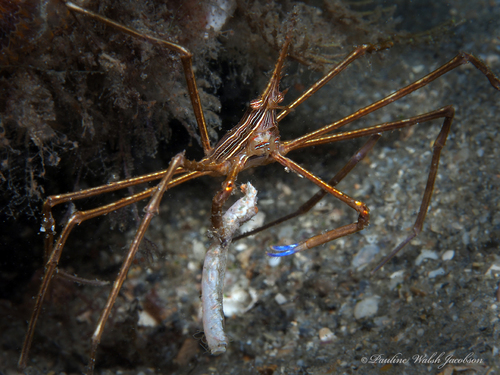
Stenorhynchus seticornis (Herbst, 1788) has a triangular body, with a rostrum drawn out into a long point with serrated edges. Its legs are long and thin, and the crab can measure up to 10 cm (3.9 in) across, while its carapace may reach up to 6 cm (2.4 in) in length. Colouration varies across the species: the body may be golden, yellow or cream, marked with brown, black or iridescent-blue lines; legs are reddish or yellow, and claws are blue or violet. Diagnostic features for this species include a triangular body with a long pointed snout (rostrum), a carapace patterned with fine dark lines, and claws that often have violet tips. In southeastern Brazil, this species is most commonly associated with anemones, found in groups of one to six individuals. Stenorhynchus seticornis is commonly found in shallow subtidal areas on rock bottoms, corals, calcareous algae, and soft sediments such as shelly gravel and sand. Its geographical range is limited to the Western Atlantic, from North Carolina and Bermuda to Argentina, including throughout the Caribbean Sea. It lives on coral reefs at depths of 3.0–9.1 m (10–30 feet). Stenorhynchus seticornis is nocturnal and territorial. It displays strong negative phototaxis, meaning it avoids sunlight, and changes location between day and night. It feeds on small feather duster worms and other coral reef invertebrates, and is commonly kept in reef aquariums to control bristle worm populations. This crab is one of several invertebrates that live in association with the sea anemone Lebrunia danae, and is often found among the anemone's pseudotentacles alongside Pederson's cleaning shrimp (Ancylomenes pedersoni) and the spotted cleaner shrimp (Periclimenes yucatanicus). The species is also known for decorating its body by attaching materials: this provides camouflage, or if the attached organisms are noxious, it acts as aposematism to ward off predators. There have been many reports of cleaning symbiosis between this crab and reef fish, including moray eels and squirrelfish. This relationship is somewhat unexpected, as moray eels and squirrelfish normally eat crabs as an important part of their diet. This cleaning behavior has only been observed in natural conditions in Brazilian waters, but it is thought to occur across the entire distribution of the species. During mating, the male deposits a spermatophore on the female, who uses it to fertilize her eggs. The fertilized eggs are carried on the female's pleopods until they are ready to hatch into zoea larvae. These larvae swim to the ocean surface and feed on plankton, growing through a series of moults before eventually metamorphosing into the adult form. When mature, the spermatozoa of S. seticornis have five lateral arms, a similar sperm morphology to that of Inachus phalangium.