About Stenopus hispidus (Olivier, 1811)
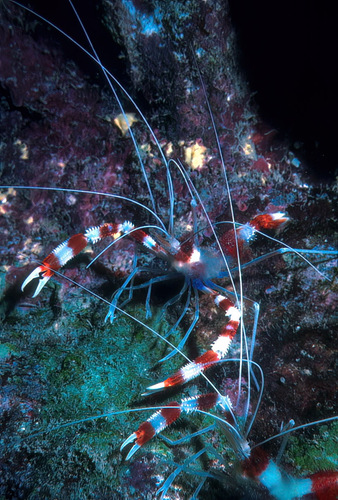
Stenopus hispidus reaches a total length of 60 millimeters (2.4 in) and has distinctive striking coloration. Its base body tone is transparent, while the carapace, abdomen, and large third pereiopod are banded in alternating red and white. The antennae and all other pereiopods are solid white. The carapace, abdomen, and third pereiopods are covered in spines. This species is able to recognize other individuals of its own species, an uncommon trait among invertebrates that is most likely achieved through detection of chemical signals. Stenopus hispidus has a pan-tropical distribution that extends into some temperate regions. It occurs in the western Atlantic Ocean from Canada south to Brazil, including the Gulf of Mexico. In Australia, it can be found as far south as Sydney, and it also lives around New Zealand. This species lives below the intertidal zone down to a maximum depth of 210 meters (690 ft), where it inhabits coral reefs. It is a cleaner shrimp, and advertises its cleaning services to passing fish by slowly waving its long white antennae. To do this, S. hispidus performs a characteristic dancing behavior: it stays close to its reef home while moving side to side and waving its antenna. This dancing behavior was first observed in laboratory conditions by Becker et al. in 2000, which confirmed that the dance acts as a signal to tell nearby fish the shrimp is ready to clean. S. hispidus uses its three pairs of claws to remove parasites, fungi, and damaged tissue from host fish. Stenopus hispidus is monogamous; females are typically larger than males. Breeding pairs occupy a shared territory that ranges from 1 to 2 meters in diameter.