About Stenocereus treleasei (Rose) Backeb.
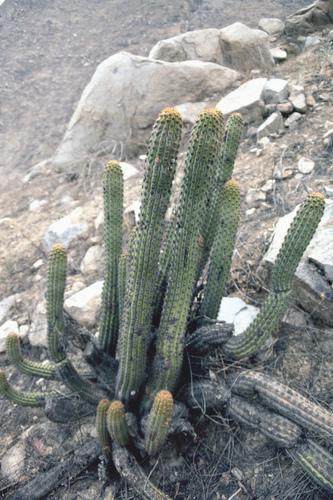
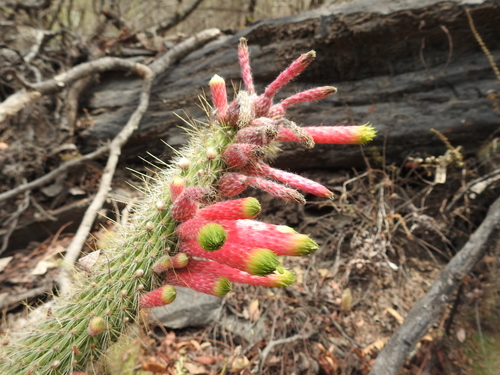
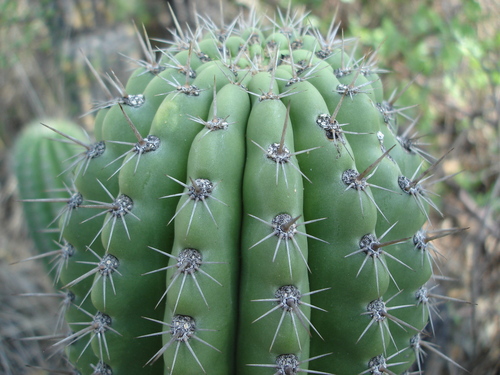
Stenocereus treleasei (Rose) Backeb. is a shrubby, candelabriform cactus. Mature individuals can grow up to 15 m (49 ft) tall, with multiple branches growing from a central trunk or base. Branches are dark to bluish green, can reach up to 22 cm (8.7 in) in diameter, and feature 15 to 20 blunt, slightly curved ribs. Areoles are pale and circular, spaced 2 cm (0.79 in) to 2.5 cm (0.98 in) apart, and bear more than ten radial spines. Spines are gray, and range from 0.4 cm (0.16 in) to 1.3 cm (0.51 in) long. The flowers of this cactus have pink or red tepals and numerous yellowish-white stamens. Fruits are either ellipsoid or spherical, measuring 3 cm (1.2 in) to 5 cm (2.0 in) in length and 2.5 cm (0.98 in) to 4 cm (1.6 in) in width. Fruits have a red outer peel, pulp that can be red, orange, yellow, or purple, and contain black seeds. This species is distributed in the Mexican state of Oaxaca, occurring at altitudes between 1,300 and 1,800 meters. It is a characteristic species of the Central Valleys of Oaxaca, found across an elevation range of roughly 1,200 metres (3,900 ft) to 2,000 metres (6,600 ft). It grows in valleys and slopes as part of thorn-scrub and tropical dry forest communities, in soils formed from volcanic rocks and limestones. In some regions, S. treleasei becomes the dominant plant in local plant associations that local people call pitayeras or tunillales. In these areas, it is commonly associated with multiple Bursera species, Ceiba aesculifolia, Vachellia cochlyacantha, Vachellia acatlensis, Mimosa species, Senna species, Parkinsonia praecox, Ipomoea arborescens, Ipomoea murucoides, Agave americana, Agave potatorum, Agave karwinski, multiple columnar cactus species including Lophocereus marginatus, Myrtillocactus geometrizans, and Myrtillocactus schenckii, and many other species.