About Stenocereus dumortieri (Scheidw.) Buxb.
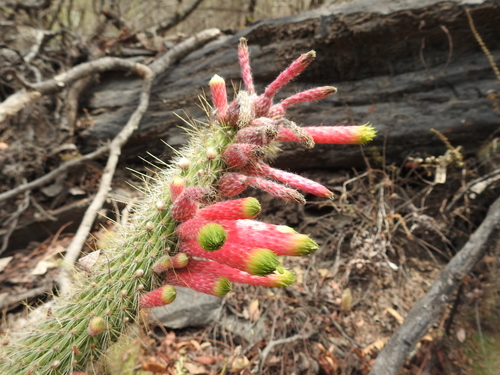
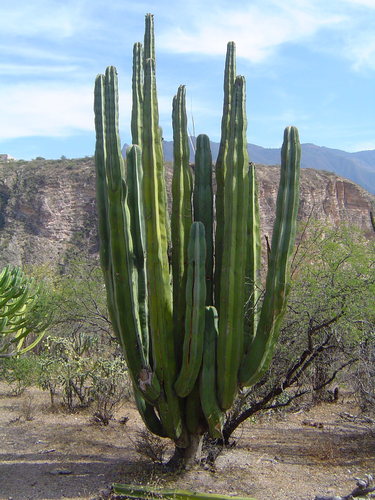
This species, currently classified scientifically as Stenocereus dumortieri (Scheidw.) Buxb., is also referenced as Isolatocereus dumortieri. It is a large, tree-like, candelabra-shaped cactus that grows 5 to 15 meters tall. It has a trunk over 1 to 1.5 meters long and about 35 centimeters wide. The plant is blue-green and covered in grayish wax. Its branches are erect, grow parallel to one another, are all roughly the same length, curve at the base, and have tapered tips; individual branches reach up to 10 meters long and 5 to 15 centimeters in diameter. This cactus has 5 to 8 bluntly triangular ribs that grow up to 2 centimeters high, and its areoles are dark. It produces 1 to 4 yellowish-white central spines that reach up to 5 centimeters long, plus 6 to 9 shorter reddish-brown woolly structures and some short bristly radial spines. The radial spines darken as they age and reach 1 centimeter in length. Scentless tubular flowers grow near the shoot tips, and bloom multiple times, sometimes forming small crowns. The species is mostly self-incompatible. Flowers open at night and stay open until midday; they are pale green to white, tubular to funnel-shaped, and measure 2.5 to 3.5 centimeters long. The edible fruits are subglobose to ellipsoid. Fruits stay green for some time, then turn orange to red, and are 2.5 to 3.5 centimeters long. They are covered in small red scales and contain black seeds that are approximately 1.5 millimeters in size. Fruits have red pulp, measure 3 to 4 centimeters long and 2 to 3.5 centimeters wide, and are covered with short podaries arranged in 4 series. Their areoles have a reduced deltoid basal scab and short emerging felt, with very short spines. Fruits split open at the apex, release a pleasant jasmine-like aroma, and are very juicy, fleshy and sweet when ripe. Isolatocereus dumortieri is native to multiple Mexican states: Aguascalientes, Guanajuato, Guerrero, Hidalgo, Jalisco, México, Michoacán, Morelos, Oaxaca, Puebla, Querétaro, San Luis Potosí, Veracruz, and Zacatecas. It grows at elevations between 1100 and 2200 meters. It occurs in deciduous forest and grassland habitats, growing on slopes or rocky cliffs alongside the cactus Cephalocereus senilis. Flowers are pollinated by nectar-feeding animals, including the hummingbirds Amazilia violiceps, Cynanthus sordidus, and Cynanthus latirostris; the bats Leptonycteris yerbabuenae, Leptonycteris nivalis, Glossophaga soricina, Choeronycteris mexicana, Sturnira lilium parvidens, and Dermanura tolteca; and bees. Seeds are dispersed by bats and Bassariscus astutus, a species that eats the cactus's fruits.