About Stenella frontalis (G.Cuvier, 1829)
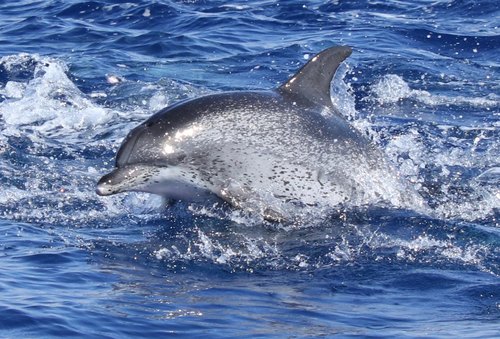
The Atlantic spotted dolphin, scientifically named Stenella frontalis (G.Cuvier, 1829), undergoes massive changes in coloration as it grows, with age-dependent color phases classified as two-tone, speckled, mottled, and fused. Calves are fairly uniformly gray-white, with one spot or no spots at all. Speckling develops once calves are weaned, typically appearing between 3 and 4 years of age and lasting an average of 5 years. A juvenile enters the mottled phase when it develops merging gray and white spots on its dorsal surface and black spots on its ventral surface; this usually occurs between 8 and 9 years of age. The fused pattern develops when dark and white spots appear on both the ventral and dorsal sides. As the dolphin matures, its spots become denser and spread across the body, until fully mature individuals appear black with white spots. The Atlantic spotted dolphin is a medium-sized dolphin compared to other dolphin species. Newborn calves measure approximately 35–43 inches (89–109 cm) in length. Adult males reach up to 2.26 m (7 ft 5 in) long and weigh up to 140 kg (310 lb), while adult females reach up to 2.29 m (7 ft 6 in) long and weigh up to 130 kg (290 lb). Compared to the much smaller pantropical spotted dolphin, the Atlantic spotted dolphin has a more robust body shape. It shares its habitat with both the pantropical spotted dolphin and the bottlenose dolphin. This species produces around ten distinct vocalizations, including whistles, buzzes, squawks, and barks, and each type of vocalization is associated with a different behavior. This species is endemic to temperate and tropical regions of the Atlantic Ocean. It is widely observed in the western Gulf Stream, between Florida and Bermuda. It is also present in the Gulf of Mexico. Swim-with-dolphins tourism operates off the Bahamas, where this species occurs. Less frequent sightings have been recorded further east, off the Azores and Canary Islands. Northerly sightings have been recorded as far north as Cape Cod, across to the southwestern tip of Spain. The species is confirmed to occur as far south as Rio Grande do Sul in Brazil, and across to west Africa, but its distribution in these southern areas is not well understood. Around 20 years ago, only about 80 Atlantic spotted dolphins were recorded in the Bahamas. Currently, almost 200 dolphins are found there. Because the Atlantic spotted dolphin looks very similar to other dolphins that live in its range, it is difficult to get an accurate count of its total population. A conservative estimate puts the total global population at around 100,000 individuals.