About Stenella coeruleoalba (Meyen, 1833)
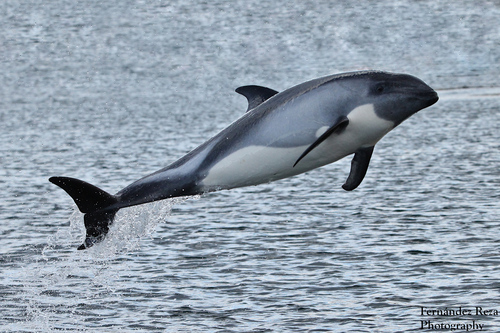
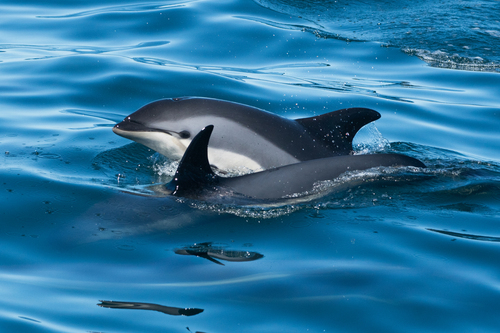
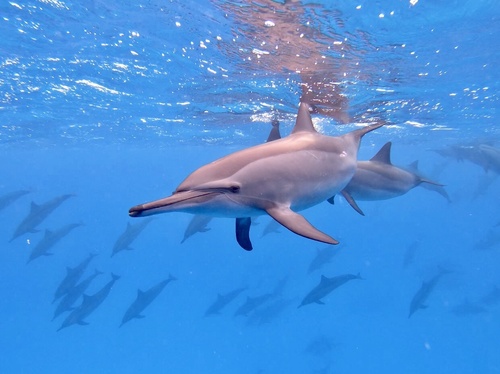
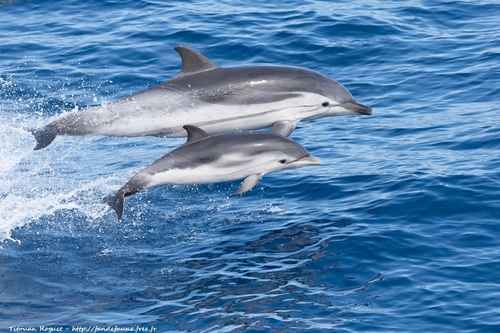
Stenella coeruleoalba, commonly called the striped dolphin, shares a similar size and body shape with several other dolphin species that share the same waters, including the pantropical spotted dolphin, Atlantic spotted dolphin, and Clymene dolphin. However, its distinct colouring makes it relatively easy to identify at sea. Its underside can be blue, white, or pink. One or two black bands circle the eyes, then extend across the back to the flipper. These bands widen to match the width of the similarly sized flipper. Two additional black stripes run from behind the ear: one is short and ends just above the flipper, while the other is longer, thickening along the flanks before curving down under the belly just before the tail stock. Above these stripes, the dolphin’s flanks are coloured light blue or grey, and all of its appendages are also black. Newborn striped dolphins weigh about 10 kg (22 lb) and reach up to 1 meter (3 feet) in length at birth. When fully grown, adult females reach 2.4 m (7.9 ft) in length and weigh 150 kg (330 lb), while adult males reach 2.6 m (8 ft 6 in) and weigh 160 kg (350 lb). Research indicates that female striped dolphins reach sexual maturity at 12 years of age in the Mediterranean, and between 7 and 9 years of age in the Pacific. This species typically lives 55 to 60 years. Gestation lasts around 12 months, and calving occurs every 3 or 4 years. Like other dolphins in its genus, the striped dolphin travels in large groups that can number up to thousands of individuals, though groups may be smaller in the Mediterranean and Atlantic. Striped dolphin groups sometimes mix with groups of common dolphins. This species is just as capable of acrobatic movement as any other dolphin, and frequently breaches and jumps far above the water surface. In the Atlantic and Mediterranean, striped dolphins sometimes approach boats, but this behaviour is far less common in other areas, particularly the Pacific, where the species was heavily exploited in the past. Throughout the eastern tropical Pacific, striped dolphins are nicknamed "streakers" for their behaviour of swimming rapidly away from vessels to avoid collisions. They feed on small pelagic fish and squid. The striped dolphin lives in temperate or tropical offshore waters. It is abundant across the North and South Atlantic Oceans, including the Mediterranean Sea (recent sightings and strandings have been reported in the Sea of Marmara) and the Gulf of Mexico, as well as the Indian Ocean and the Pacific Ocean. Its overall range extends roughly from 40°N to 30°S. It has been recorded in waters with temperatures between 10 to 26 °C (50 to 79 °F), though its preferred temperature range is 18–22 °C (64–72 °F). In the well-studied western Pacific, the striped dolphin follows a distinctive migration pattern, and this pattern has not been observed in other parts of its range. The species appears common across most of its range, but its range is not continuous, and there are areas with low population density. The total global population of striped dolphins is over two million. The southernmost confirmed record of the species is a stranded individual found near Dunedin, southern New Zealand, in 2017.