About Stenanthera pinifolia R.Br.
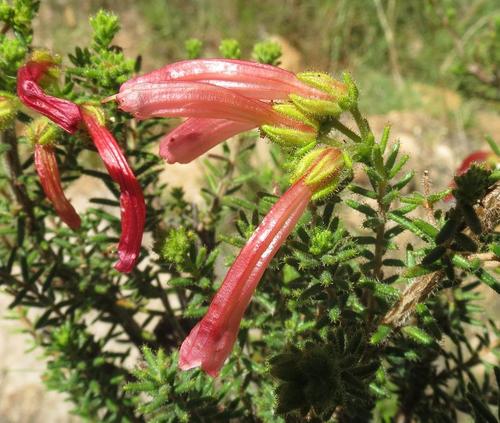
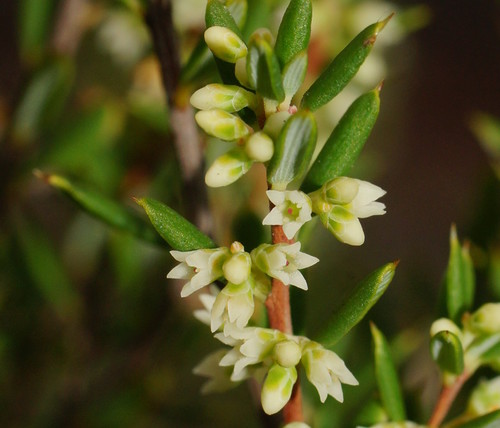
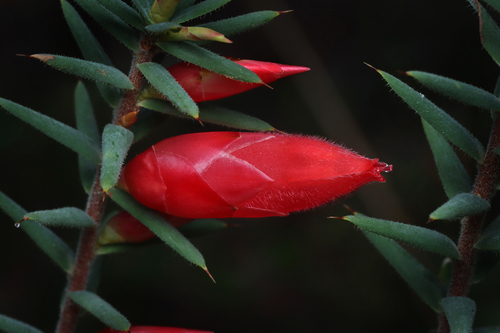
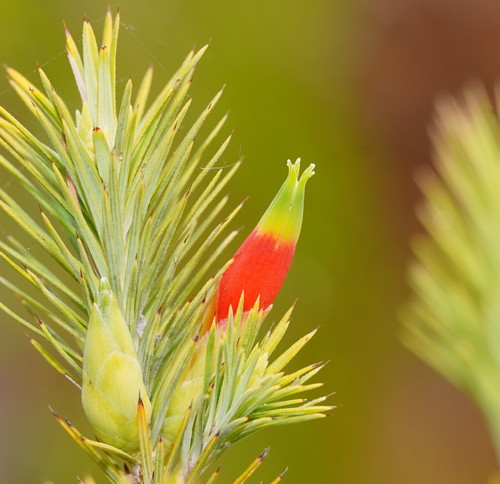
Stenanthera pinifolia is an erect, spreading, decumbent or diffuse shrub that usually grows between 15 and 100 cm (5.9 and 39.4 inches) tall. Its leaves are densely arranged along branchlets, are narrow linear in shape, measure 9.5–25 mm (0.37–0.98 in) long and 0.3–1 mm (0.012–0.039 in) wide, and feel soft to the touch. The flowers are erect, more or less sessile, and grow singly in leaf axils, though they often look clustered at the base of branches. At the base of each flower, there are bracts 0.5–8 mm (0.020–0.315 in) long and bracteoles 7–9 mm (0.28–0.35 in) long. The sepals are egg-shaped and 9–12 mm (0.35–0.47 in) long. The petal tube is roughly cylindrical, 9–20 mm (0.35–0.79 in) long, mostly yellow, and sometimes reddish near the base. The petal lobes are triangular, green, 4–6 mm (0.16–0.24 in) long, and densely hairy on the inside. The anthers extend beyond the end of the petal tube, and the style is 11–16 mm (0.43–0.63 in) long. The fruit is an edible berry that ranges from oval to globe-shaped, is about 5–15 mm (0.20–0.59 in) long, and turns white when it matures. Flowering takes place from spring through summer. Common name pine heath, this species mainly grows in open forest, and heathy woodland or forest, on well-drained sandy soils or rocky locations. It is found along the coast and nearby tablelands of New South Wales, south of Evans Head. In Victoria, it occurs mainly in the Grampians and can also be found further east, and it also grows in Tasmania. It grows alongside other plant species including Eucalyptus sieberi, Eucalyptus globoidea, Angophora costata, Allocasuarina distyla, and Banksia ericifolia. The Tasmanian subspecies of the grey currawong, locally known as the clinking currawong or black jay, appears particularly fond of the berries of this plant. One observer noted that these normally noisy birds became sluggish and quiet after eating the berries, and wondered if the plant had a narcotic effect on the birds.