About Stellaria neglecta (Lej.) Weihe
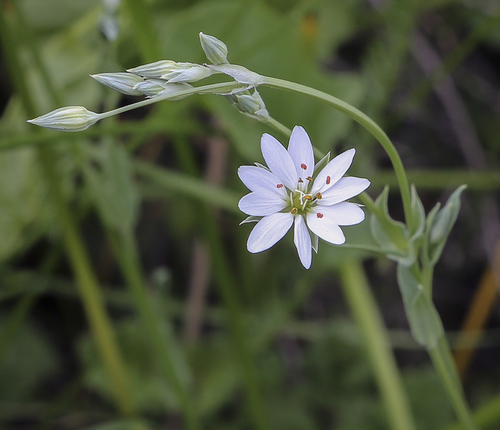
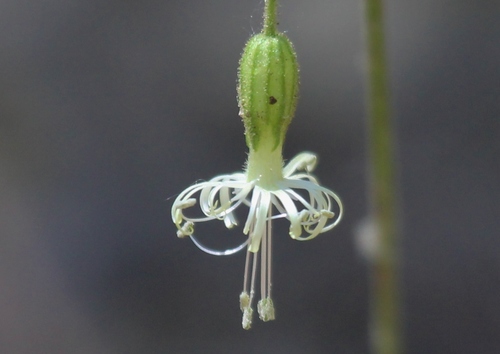
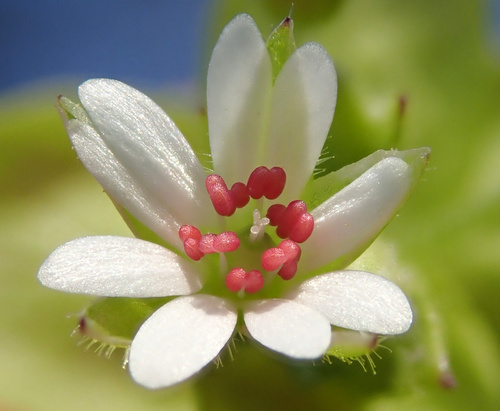
This plant, commonly called greater chickweed, is a sprawling annual that can also act as a short-lived perennial. It has weak branching stems, which are typically decumbent at the base and ascending towards the tips, reaching around 80–90 cm in height, and are often supported by other surrounding plants. Stems are cylindrical and mostly hairless, except for a single lengthwise line of hairs that changes sides at each node. Other plant parts are usually completely hairless. Leaves grow in opposite pairs: lower leaves have long (2–5 cm), narrowly winged stalks and a broadly oval-triangular blade around 3 cm long by 1.5 cm wide. Upper leaves are stalkless or have only very short stalks, and are slightly larger and more oval in shape. Each leaf has one strong central midrib and around 5 lateral veins on each side of the midrib. Flowers grow singly in the uppermost leaf axils, borne on slender 2–3 cm stalks. The stalks are initially spreading and curved downward, becoming erect as the flower matures. Each flower has five lanceolate sepals 5–6.5 mm long, which are hairless or rarely hairy, with a pointed apex. It also has five white petals that are split almost to their base, creating the appearance of ten separate petals. Petals are typically about the same length as the sepals or just slightly shorter, and the whole flower measures around 10 mm in diameter. There are 8–10 stamens with reddish anthers, and three styles. In Northern Europe, flowering occurs between April and July. Stems can remain alive and produce tillers that overwinter to flower the following year. Seeds are dark reddish-brown, 1.3–1.7 mm in diameter, and covered in tubercles. The tubercles are conical with a pointed apex. Three chickweed species share the trait of having a single line of hairs running down the stem, and several features can be used to tell them apart. Stellaria apetala usually has 1–3 stamens and no white petals; Stellaria media has 3–8 stamens and white petals up to 3 mm long; while Stellaria neglecta usually has 10 stamens and petals up to 4 mm long. Since anthers often fall off, it is recommended to count the filaments instead. When flowers are not present, plant size and leaf size are useful identification traits: maximum plant size is 10 cm for S. apetala, 25 cm for S. media, and 100 cm for S. neglecta; maximum leaf length is 7 mm for S. apetala, 25 mm for S. media, and 50 mm for S. neglecta, and the leaves also have a different appearance across the three species. Greater chickweed is widely distributed throughout Europe and southern Asia, reaching as far east as Japan. In Great Britain, it is most common in the south and west of the country. It was formerly rare in North America, but has spread rapidly in recent decades, and is now classified as a weed in several states ranging from Maryland to California. Its global conservation status has not been evaluated, but in Britain it is classified as Least Concern because it remains widespread, despite experiencing population decline. In France, it is not considered threatened overall, except in the Alsace region where it is classified as vulnerable. Greater chickweed grows in lightly shaded locations on slightly damp, base-rich, moderately fertile soils. Its Ellenberg values in Britain are L = 6, F = 7, R = 6, N = 7, and S = 0. It is often found in old hedgerows and on the margins and paths of ancient deciduous woodland, where it generally occurs sparsely in small patches. In the British National Vegetation Classification, it has been recorded in MG1 false oatgrass swards on woodland edges, W6 crack willow woodland alongside rivers, W10 oak woodland, and W24 bramble scrub in hedges. Because it is relatively scarce, declining, and mostly restricted to old hedges and ancient woodland, it is considered an axiophyte in some British counties. It is strictly a lowland plant, reaching its highest recorded altitude of 345 m in Britain on Stapeley Hill in Shropshire. Likely due to being a poorly studied species, there are no recorded insect associations with this species in Britain, and there are also no known galls, rusts or smuts that affect it.