About Stellaria media (L.) Vill.
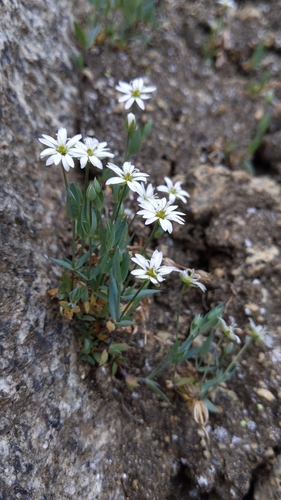
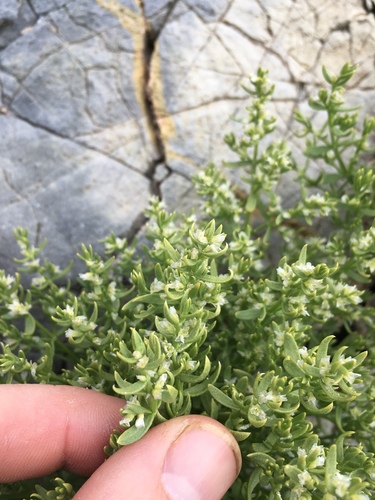
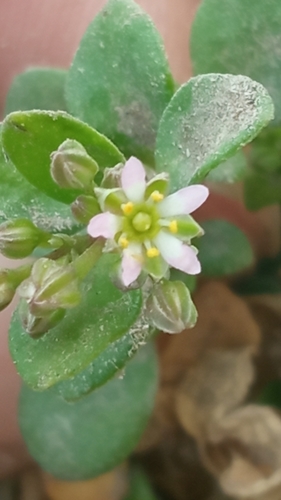
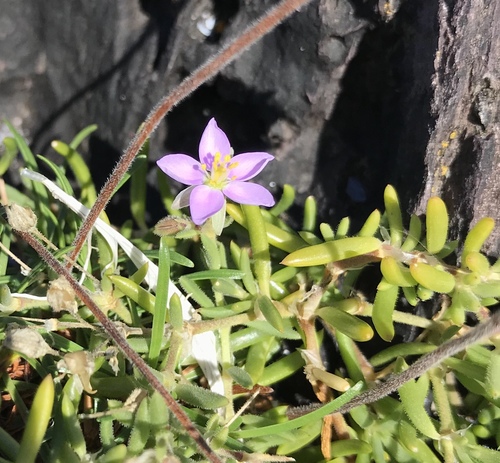
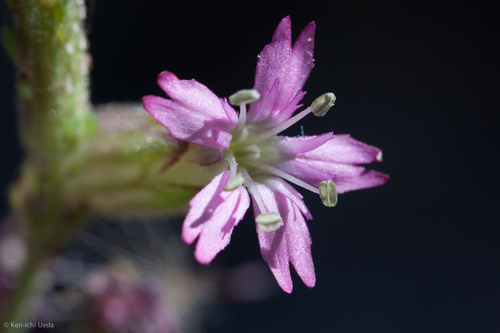
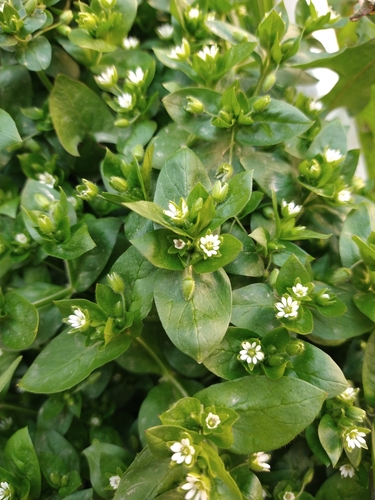
Stellaria media, commonly called chickweed, is a hardy annual plant that flowers year-round in mild weather across northern Europe. Its stems are cylindrical, hairless except for one (very rarely two) lines of straight hairs that alternate sides at each node. The stems have a lax, sprawling growth habit, reaching up to 40 cm (16 inches) in length and 1 millimetre (1⁄16 inch) in diameter. Petioles measure 5 to 8 mm long and have hairy margins. Leaves are green, hairless, oval, arranged oppositely, 6 to 25 mm (1⁄4 to 1 inch) long by 3 to 10 mm (1⁄8 to 3⁄8 inch) wide, and have a hydathode at the tip. Flowers are small, less than 1 cm in diameter, with 5 notched white petals 1–3 mm long, which sit inside larger 3–5 mm long sepals. The sepals are usually 5 in number, oval in shape, and covered in long soft wavy (villous) hairs on their outer distal sides. Flowers most often have 3 stamens, but can have up to 8, along with 3 styles. Many published sources note that chickweed sometimes has no petals, but this claim likely comes from confusion with lesser chickweed, once classified as a subspecies of Stellaria media but now recognized as a separate species. After flowering, the plant quickly forms seed capsules, and individual plants may bear both flowers and capsules at the same time. Stellaria media is widespread across Asia, Europe, North America, and other regions of the world. Several closely related plants are also called chickweed, but these lack the culinary properties of species in the genus Stellaria. Stellaria media is commonly found in lawns, meadows, waste places, and open areas. Its Ellenberg values for Britain are L = 7, F = 5, R = 6, N = 7, and S = 0. In ecology, larvae of multiple lepidopteran species feed on chickweed: these include the chickweed geometer (Haematopis grataria), yellow shell (Camptogramma bilineata), pale-banded dart (Agnorisma badinodis), dusky cutworm (Agrotis venerabilis), and dainty sulphur (Nathalis iole). The species is susceptible to downy mildew caused by the oomycete Peronospora alsinearum. Chickens, wild birds, and mountain sheep feed on this plant. Chickweed contains saponins, plant compounds that can be toxic to some species, most notably fish. The small quantities present in the plant mean most land animals are unlikely to be affected, but the plant is not recommended for use during pregnancy or while breastfeeding. Stellaria media is edible and nutritious, used as a leaf vegetable, most often eaten raw in salads. It is one of the ingredients of the traditional symbolic dish served at the Japanese spring festival Nanakusa-no-sekku. Some varieties or similar closely related species may be too fibrous to eat. It is attributed with medicinal properties and used in folk medicine, where it has been employed as a treatment for itchy skin conditions and pulmonary diseases. 17th-century herbalist John Gerard recommended it as a remedy for mange. Modern herbalists prescribe it for iron-deficiency anemia due to its high iron content, as well as for skin diseases, bronchitis, rheumatic pains, arthritis, and period pain. None of these medicinal uses are supported by scientific evidence. The Ainu people used this plant to treat bruises and aching bones: stems were steeped in hot water, then applied externally to affected areas.