About Stellaria apetala Bernardino
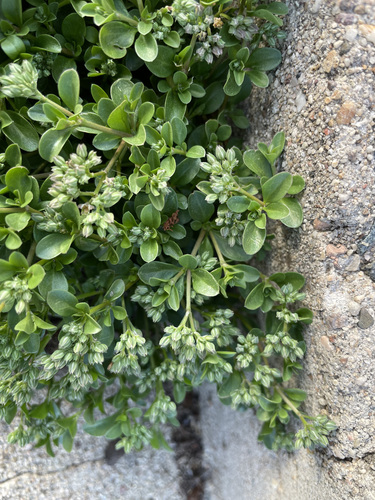
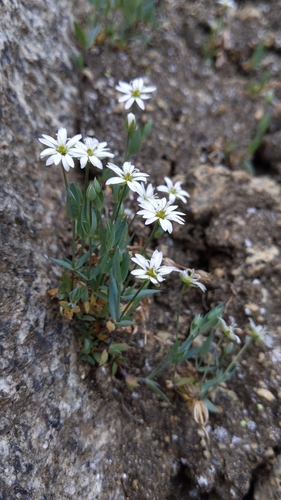
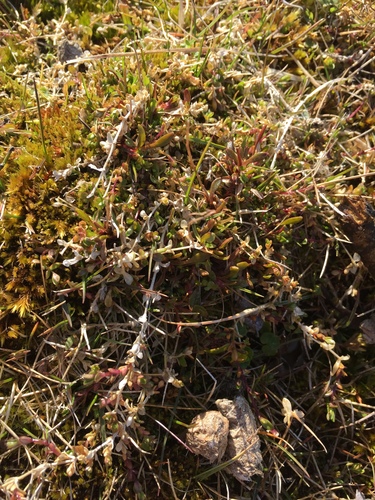
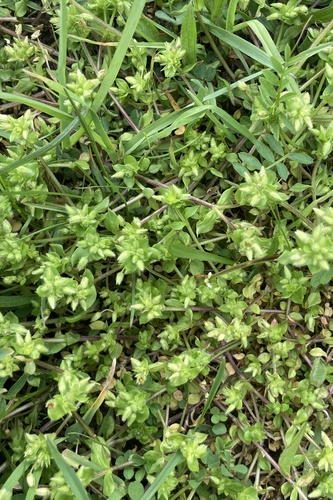
Stellaria apetala Bernardino, commonly known as lesser chickweed, is a low-growing, patch-forming annual herb with a distinct yellowish-green color. It produces a dense, spreading root mat that makes it hard to dislodge from soil. Its stems, which are sometimes purple-tinged, grow up to around 10 cm long, spreading along the ground without rooting at the nodes. Stems are cylindrical and hairless except for a single line of hairs running down one side that alternates position at each node. Leaves are arranged oppositely; they are pale green and ovate, measuring 4–7 mm long by 2–3 mm wide. Each leaf has a pointed tip that bears a pale green or sometimes purple hydathode, and stomata are present on both leaf surfaces. Leaf petioles are flattened, hairy, and approximately 3–5 mm long, though leaves at the tip of the stem appear sessile. Flowering occurs in early spring, from February to May in Northern Europe. Inflorescences form at stem tips as short cymes holding up to six small flowers, each 2–3 mm in diameter. Flowers have 4 or 5 hairy, oval to lanceolate green sepals that measure 2–3.5 mm long. Most flowers lack petals entirely, but a small percentage produce five deeply split green or scarious petals roughly 1 mm longer than the sepals, which never open widely. Flowers usually have between one and three stamens, and sometimes have none at all, with grey-violet anthers, plus three styles. Fruits develop one to two weeks after flowering. They are oval green capsules around 3 mm long that remain enclosed by the sepals. Each fruit holds approximately 6 to 8 yellowish-brown, disc-shaped seeds. Seeds are released when the fruit tip opens via six spreading teeth; they measure 0.5–0.8 mm in diameter, with a ring of small, blunt tubercles around their edge. Stellaria apetala is self-pollinating, and often cleistogamous because its flowers do not open widely. Lesser chickweed is easily confused with common chickweed (Stellaria media), especially small apetalous forms of common chickweed known as Stellaria media var. apetala Gaudin. The only definitive method to separate the two species is a chromosome count, but several field traits can help distinguish them. Lesser chickweed is yellowish rather than bright green; its sepals reach a maximum length of 3 mm, compared to 5 mm for common chickweed; it has 3 or fewer stamens, while common chickweed has 3 to 10; its fruiting capsules are less than 5 mm long; its fruiting pedicels are short and not curved backward; and its ripe seeds are less than 0.9 mm long. Stellaria apetala has a widespread but localized distribution across Europe, ranging from southern Spain and Mediterranean islands to Lapland, and from the British Isles to Ukraine. In North America it is an introduced species, found from Ontario, Canada, through the United States (from the east coast states of Virginia, North Carolina, South Carolina, and Florida to the west coast states of California and Washington) and into Mexico. It is also established in many other countries around the world. Its threat status has not yet been evaluated for the European Union, but it is designated Least Concern in Britain. The primary habitat of this species is sandy and gravelly grassland near the shore. It grows on well-drained soils and can tolerate a moderate amount of trampling and grazing. In inland areas it occurs in sandy regions, and can be found on woodland rides, waste ground, and eroded hillsides. In Europe, it often grows in the shade of Scots Pine in woodlands growing on light glacial sands. In Britain, it is commonly found in the distinctive U1 Rumex acetosella grassland community, where it is sometimes considered an axiophyte of species-rich habitats. Because its flowers are cleistogamous, they are not visited by pollinating insects. The UK Database of Insects and their Food Plants records no insect species that feed specifically on lesser chickweed, though several types of Diptera and other insects are known to feed on chickweeds (Stellaria spp.) in general. Its Ellenberg values recorded in Britain are L = 7, F = 4, R = 4, N = 4, and S = 0, which correspond to growth in brightly lit locations with dry, moderately acidic, low-fertility soil and no salt.