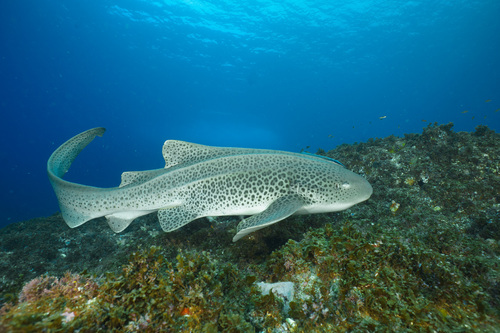
About Stegostoma fasciatum (Hermann, 1783)
Stegostoma fasciatum, commonly called the zebra shark, has a cylindrical body with a large, slightly flattened head and a short, blunt snout. Its small eyes sit on the sides of the head, and equally sized or larger spiracles are located behind the eyes. Of the five short gill slits, the last three are positioned over the bases of the pectoral fins, with the fourth and fifth slits placed much closer together than the other slits. Each nostril has a short barbel and a groove that extends from the nostril to the mouth. The mouth is nearly straight, with three lobes on the lower lip and furrows at the corners. There are 28–33 tooth rows in the upper jaw and 22–32 tooth rows in the lower jaw; each tooth has a large central cusp, with one smaller cusp flanking it on each side. Adult zebra sharks have five distinctive ridges running along their bodies: one along the dorsal midline and two on each side. The dorsal midline ridge connects to the first dorsal fin, which is positioned roughly halfway along the body and is twice as large as the second dorsal fin. The pectoral fins are large and broad; the pelvic and anal fins are much smaller than the pectoral fins, but larger than the second dorsal fin. The caudal fin is almost as long as the rest of the shark’s body, with a barely developed lower lobe and a prominent ventral notch near the tip of the upper lobe. Zebra sharks typically reach a length of 2.5 m (8 ft 2 in), and there is one unsubstantiated record of an individual reaching 3.5 m (11 ft 6 in). Males and females do not differ in size. Young zebra sharks have a dark brown upper body and light yellow lower body, marked with vertical yellow stripes and spots. When sharks grow to 50–90 cm (20–35 in) long, the dark areas of their pattern begin to break up, shifting the overall pattern from light-on-dark stripes to dark-on-light spots. Adults have substantial pattern variation, which can be used to identify individual sharks. A rare informal morph called the sandy zebra shark is overall sandy-brown, with faint inconspicuous dark brown freckles on its upper side, and lacks the distinct dark-spotted or banded pattern typical of the species. The appearance of juvenile sandy zebra sharks is unknown, but transitioning subadults have a brown-netted pattern, and faint traces of this pattern often remain in adults. This morph is genetically identical to the typical morph, and is only confirmed to occur near Malindi, Kenya, though similar individuals have been reported from Japan and northwestern Australia. In 1964, a partially albino zebra shark was found in the Indian Ocean. The individual was an overall white mature female 1.9 m (6 ft 3 in) long that completely lacked spots, but had the species-typical blackish-brown eyes unlike fully albino animals. This individual was unusual because albino animals rarely survive long in the wild due to their lack of crypsis. The zebra shark lives in tropical waters across the Indo-Pacific region, ranging from South Africa to the Red Sea and Persian Gulf, including Madagascar and the Maldives, east to India, Southeast Asia including Indonesia, the Philippines, and Palau, north to Taiwan and Japan, east further to New Caledonia and Tonga, and south to northern Australia. It is a bottom-dwelling species found from the intertidal zone down to a depth of 62 m (200 ft) on continental and insular shelves. Adults and large juveniles most often occur around coral reefs, rubble, and sandy areas. There are unsubstantiated reports of this species in fresh water in the Philippines. Zebra sharks sometimes cross open ocean waters to reach isolated seamounts. Individual sharks have been recorded moving distances of up to 140 km (87 mi), but genetic data shows that there is very little genetic exchange between different zebra shark populations, even when their ranges are adjacent. During the day, zebra sharks are sluggish and usually rest on the sea bottom. They sometimes use their pectoral fins to prop up the front of their bodies, and face into the current with their mouths open to make respiration easier. They prefer to rest in reef channels, because the narrowed space creates faster, more oxygenated water. They become more active at night or when food becomes available. Zebra sharks are strong, agile swimmers that move by making pronounced eel-like (anguilliform) undulations of their body and tail. They have also been observed hovering in place in steady currents by making sinuous waves with their tails. The zebra shark feeds mostly on shelled molluscs, but it also eats crustaceans, small bony fishes, and possibly sea snakes. Its slender, flexible body lets it wriggle into narrow holes and crevices to search for food, while its small mouth and thickly muscled buccal cavity allow it to generate strong suction to pull prey out of hiding. Potential predators of this species include larger fishes, especially other much larger sharks, and marine mammals. Four species of tapeworm in the genus Pedibothrium are known parasites of the zebra shark.

