About Stegodyphus sarasinorum Karsch, 1892
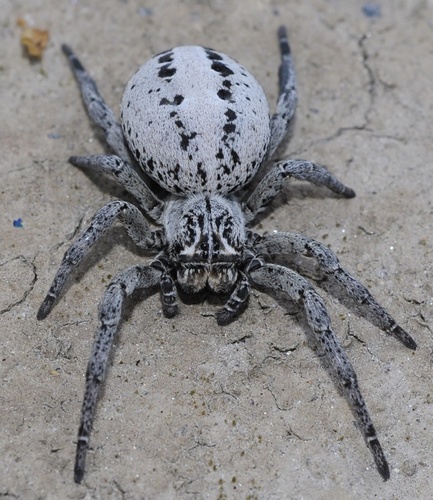
Stegodyphus sarasinorum is a spider species first described by Karsch in 1892. Like most members of the Eresidae family, these spiders have short, stout bodies covered in several fine hairs. These fine hairs give the spiders an ash-colored appearance. The dorsal side of the abdomen has a pattern of three longitudinal white stripes and six pairs of dots. The spider's six spinnerets sit on two irregular surfaces, all enclosed within a structure called the cribellum. Unlike most spiders, S. sarasinorum does not have a well-defined cephalic groove. It has eight eyes arranged in two rows of four; the front row faces forward, and the other row faces to the sides, giving the spider a wider range of vision. Its modified mandibles, called falces, are black, and its curved claws sit on the sides of the body for defense. This species is native to south and southeast Asia, and is most commonly found in India, Sri Lanka, Nepal, and Myanmar. One of its preferred habitats is the prickly pear bush, which provides strong support for its silken dwellings and webs. In some cases, the spider's dwellings cover entire bushes so thoroughly that the bush's leaves are not visible. These spiders are more abundant on bushes, trees, and fences, where sturdy surfaces make it easy to construct webs. They prefer to build nests in shaded areas, which gives them an advantage when catching prey. They also live along rivers, particularly because prey abundance is much higher near water sources. S. sarasinorum prefers to build nests over large, continuous stretches of vegetation, using fences or bridges for additional support. Social Stegodyphus species like this one are usually found in locations with complex vegetation structure and narrower reduced habitat niches, compared to solitary spider species. Higher vegetation productivity correlates with higher insect prey biomass, so the distribution of these spiders depends on the availability of suitable web-building spaces and enough insect prey to support their survival. Sturdier vegetation is necessary for nest building, because Stegodyphus spiders tend to remain in the same location permanently. Environmental conditions act as important cues for group living, which prevents loss of fitness that would result from high resource competition. The species' tendency toward group living and cooperative breeding evolved in response to high predation pressure, and consistent ample prey availability makes permanent sociality an evolutionarily stable strategy. Stegodyphus sarasinorum is a semelparous species, meaning females invest all of their time and resources into a single reproductive event. Females lay eggs in a lenticular silk-packed cocoon, and the greatest number of cocoons are produced in the month of February. A single egg sac holds between 350 and 550 eggs, and the webs surrounding these egg sacs are built to be more compact and sturdy. The cocoons are 6 mm long, white in color, and females attach them to the side walls of the nest. Juveniles hatch and tear through the cocoon walls 13 to 15 days after laying, then emerge and move to settle on their mother's back. Newly emerged young are generally round and pink, and they do not feed until after they have gone through 2 to 3 molts, at which point they begin participating in web construction. As the young juveniles grow, adult spiders already in the nest either desert the nest, or starve to death because the juveniles feed selfishly.