About Stegastes nigricans (Lacepède, 1802)
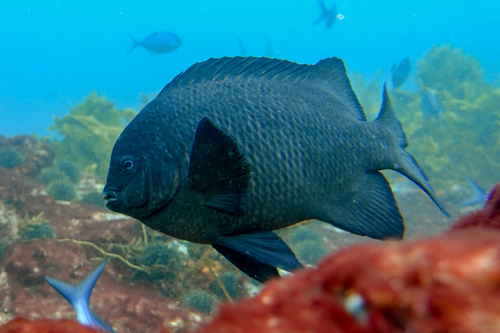
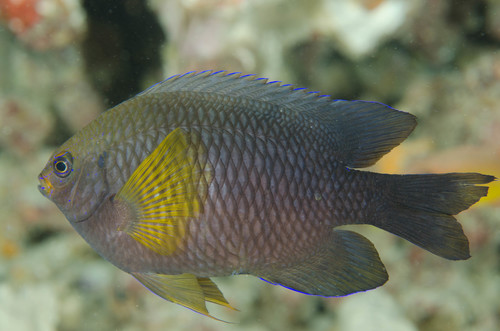
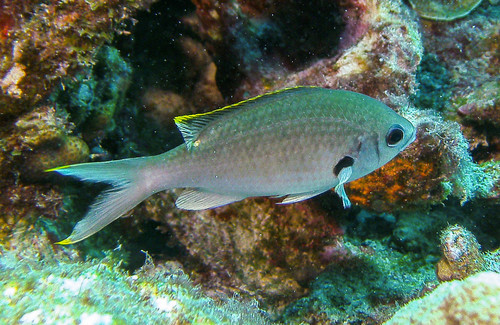
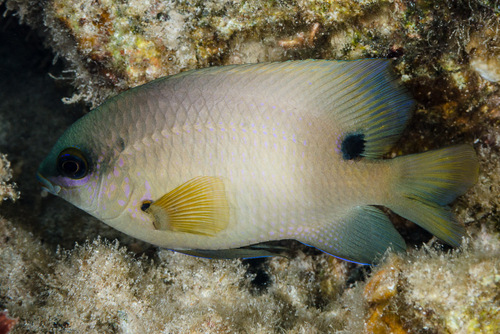
Stegastes nigricans was first described and named by Gerald Robert "Gerry" Allen and Alan R. Emery in 1985. The genus name Stegastes comes from the Greek word "stegastos", meaning covered. The species name nigricans is Greek for swarthy, black-skinned. Recent research classifies S. nigricans within the damselfish subfamily Pomacentrinae. This fish has an average total length of 9.0 cm, and can grow up to 14.0 cm long. It has 12 dorsal spines, 15 to 17 dorsal soft rays, 2 anal spines, and 12 to 14 anal soft rays. Adult Stegastes nigricans are generally brown overall. The dorsal regions of the head and nape are darker, and the color fades to tan on the lower head and breast. Its scales have darker brown edges. The lips are whitish, the suborbital is mostly blue, and the scales on the preopercle and opercle have blue centers. The median and pelvic fins are brown, while the pectoral fins are dusky. There is sometimes a distinct dark brown or blackish spot at the base of the posteriormost dorsal fin rays; this clear spot distinguishes S. nigricans from S. lividus, which has a diffuse spot at this location. When courting or guarding eggs, males develop a broad white bar across the middle of their body, and a pale blue stripe running from the mouth to the upper section of the pectoral fin. S. nigricans occurs naturally on and around coral reefs. Adult individuals live in colonies on reef flats and lagoon reefs in areas with staghorn coral. Their populations are limited by water temperature and diet, and have experienced negative impacts in recent years. Global warming and fossil fuel use have driven changes to climate and ocean chemistry, which alter this species' habitat and cause large reductions in coral reef coverage. S. nigricans is most commonly found along the coast of East Africa and around Madagascar; in the British Indian Ocean Territory and along the southern coasts of India; across Southeast Asia, along the northern coast of Australia; and throughout Melanesia, Micronesia and Polynesia. It occurs less frequently in the Red Sea, the Persian Gulf, the Gulf of California, and along the western coast of Central America.