About Steatornis caripensis von Humboldt, 1817
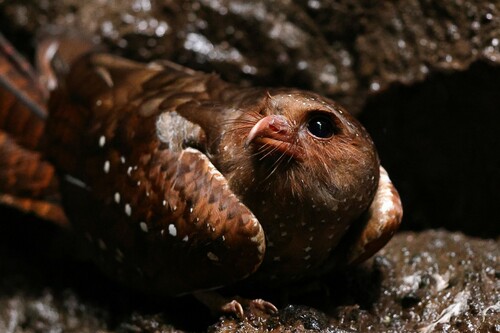
Steatornis caripensis von Humboldt, 1817, commonly called the oilbird, is a large, slim bird measuring 40–49 cm (16–19 in) in length with a 95 cm (37 in) wingspan. It has a flattened, strongly hooked beak, surrounded by deep chestnut rictal bristles that can reach up to 5 centimetres (2.0 in) long. Adult oilbirds weigh 350–475 g (12.3–16.8 oz), while chicks can weigh considerably more, reaching up to 600 grams (21 oz) before they fledge, as their parents feed them large amounts of fruit. The oilbird’s feathers are soft, similar to those of many nocturnal birds, but not as soft as the feathers of owls or nightjars, since oilbirds do not need to fly silently like predatory species. The species is mostly reddish-brown, with white spots on the nape and wings. Its underparts are cinnamon-buff, marked with white diamond-shaped spots edged in black; these spots start small near the throat and grow larger toward the rear of the body. Its stiff tail feathers are a rich brown, with white spots on each side. The oilbird’s feet are small and nearly functionless for most activities, only useful for clinging to vertical surfaces. Its long wings are adapted to allow hovering and tight turning flight, which lets the bird navigate the confined spaces of its cave habitats. Like New World vultures, its wings have deep wingtip slotting that reduces stalling speed, combined with a low aspect ratio and low wing-loading, all traits that enable steady flight at low speeds. Oilbird eyes are highly adapted for nocturnal foraging. While the eyes themselves are small, their pupils are relatively large, giving the oilbird the highest light-gathering capacity of any bird, with an f-number of 1.07. Its retina is dominated by rod cells, with 1,000,000 rods per mm²—the highest density recorded in any vertebrate eye. These rod cells are arranged in layers, an arrangement that is unique among birds but also seen in deep-sea fish. Oilbirds have low numbers of cone cells, so this overall arrangement lets them capture more light in low-light conditions, but likely gives them poor vision in daylight. Although oilbirds have specially adapted vision for foraging by sight, they are one of the few bird species known to use echolocation to supplement vision when light conditions are very poor. They produce a series of sharp audible clicks for echolocation; the only other birds known to use echolocation are some swift species. In addition to echolocation clicks, oilbirds make a range of harsh screaming calls when inside their caves. Entering a cave with a light particularly provokes these loud, raucous calls; the calls may also be heard as the birds prepare to leave the cave at dusk. The oilbird’s range extends from Guyana and Trinidad and Tobago to Venezuela, Colombia, Ecuador, Peru, Bolivia, and Brazil, and occurs from sea level up to 3,400 m (11,200 ft) in elevation. The species has specific habitat needs: it requires both caves for regular breeding and roosting, and forest with fruiting trees. Where no suitable caves exist but appropriate fruiting trees are present, oilbirds will roost and breed in narrow gorges and grottos with suitable rock shelves. One such colony in Ecuador held 100 birds in a canyon with ledges protected by vegetation. Some smaller caves and gorges are only used for roosting. While it was historically believed that oilbirds almost always roost in caves, canyons, or gullies, researchers that placed GPS trackers on non-breeding birds have found that they also regularly roost in forest trees. It is a seasonal migrant across parts of its range, leaving its breeding caves to search for fruiting trees. It has been recorded as a rare vagrant in Costa Rica, Panama, and Aruba. Cueva del Guácharo National Park (Oilbird Cave National Park), located in the mountainous Caripe district of northern Monagas, Venezuela, is the site where Alexander von Humboldt first studied the species.

