About Steatoda nobilis (Thorell, 1875)
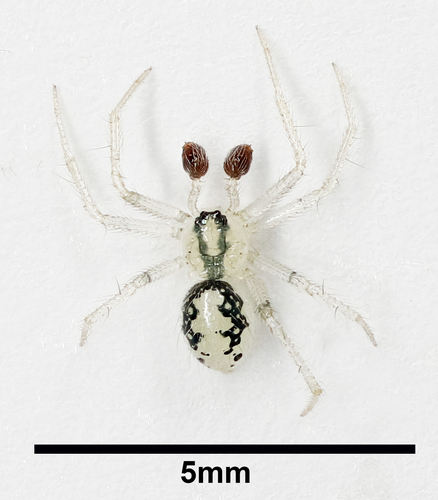
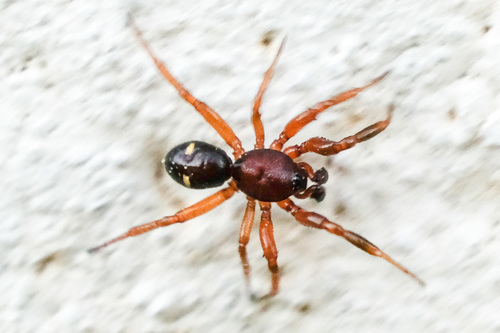
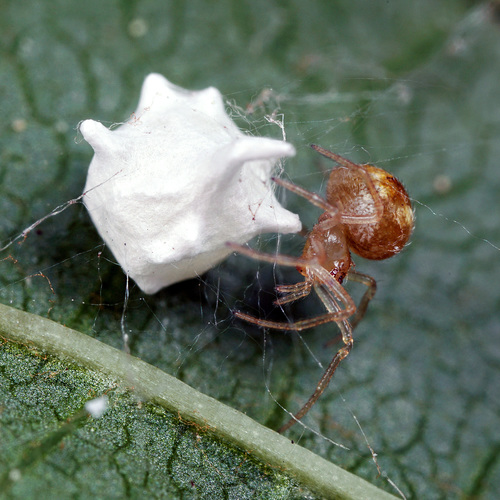
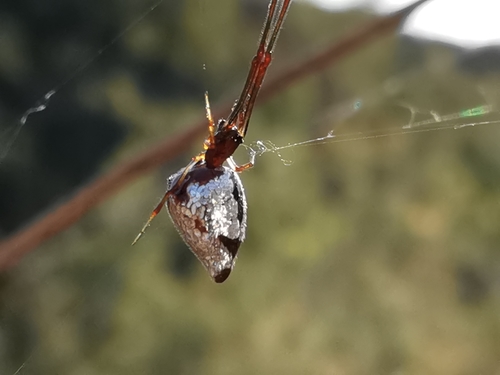
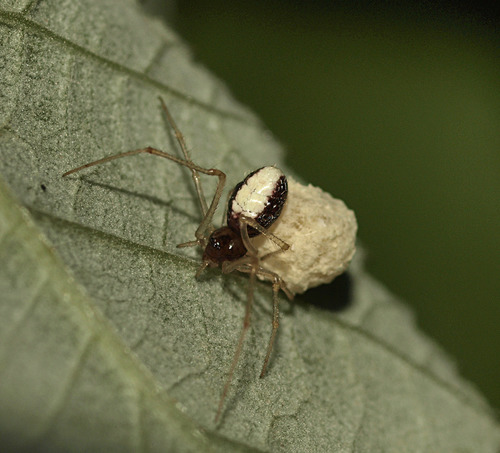
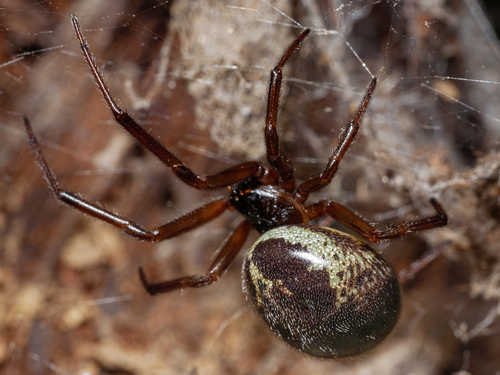
Steatoda nobilis has a brown bulbous abdomen with cream-colored markings often compared to a skull shape, and reddish-orange legs. Both female and male S. nobilis can be told apart from other members of the same genus by their large size and characteristic coloration. Females measure roughly 9.5 to 14 mm in size, while males measure 7 to 11 mm; the largest recorded females are 13.7 mm, and the largest recorded males are 11.66 mm. Males can be distinguished by the structure of their palp and their ventral abdominal markings, while females can be distinguished by their epigyne. Observed variation in size, shape, and markings is not thought to be linked to location: spiders found just centimeters apart, as well as siblings from the same egg sac, can look very different. Male and female juvenile S. nobilis cannot be told apart from one another. This spider is originally native to the Canary Islands and Madeira. It is an introduced species across Europe, parts of the United States and North Africa, and is likely continuing to spread. It was first recorded in Cologne, Germany in 2011. In England, it has mostly been reported in southern counties, but its range has been documented expanding northwards during the 21st century, and the first recorded observation of the species in England dates back to 1879. In 2011, the spider was reported as an established invasive species in Ventura County, California, USA. In January 2016, S. nobilis was found in Chile, marking the first record of the species in the southern hemisphere. Research published in December 2018 confirmed that the species is also established in Colombia and Ecuador; the first recorded observation of S. nobilis in Ecuador dates to 2014, when it was found at several locations as high as 2800 meters. The species has been present in New Zealand since at least 2023. It is considered one of the world's most invasive spider species. Seaside cities and villages with a temperate climate are particularly favorable habitats for S. nobilis. Between 1985 and 2010, large populations of S. nobilis were not reported anywhere; scientists consider this to be a typical lag phase, a phenomenon seen in many invasive species. After this period, rapid accelerated spread of the species was observed across the globe. S. nobilis is able to establish populations in urban environments and build large populations in a short amount of time. S. nobilis can be found year-round in any climate, both indoors and outdoors. It has been observed in a wide range of locations, from cacti and agave to roadside cuttings and buildings. It has also been found on telegraph poles, concrete fence posts, and ivy growing on walls. In Ireland, the species has been observed to be restricted to man-made habitats such as steel, concrete, or timber structures in urban areas, and is not commonly found in forests or dunes. A separate study conducted in Ireland found adult S. nobilis exclusively on steel, concrete, or timber structures in urban areas. In California, the species has also been observed in urban habitats, but has additionally been recorded spreading into natural habitats. Juvenile S. nobilis live in small crevices and holes, which can make eradicating the species difficult. In Dublin, juveniles have been observed on vegetation and leaves. In Ireland, S. nobilis are known to be captured by common suburban spiders including cellar spiders and lace-webbed spiders.