About Stauropus fagi (Linnaeus, 1758)
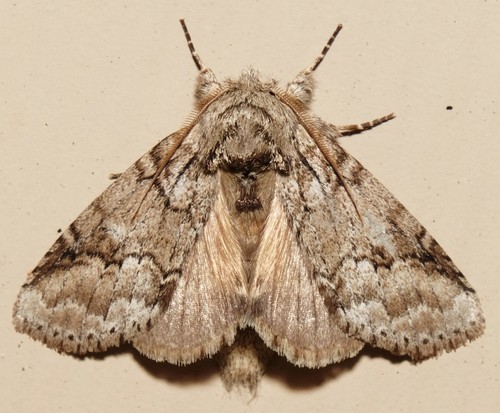
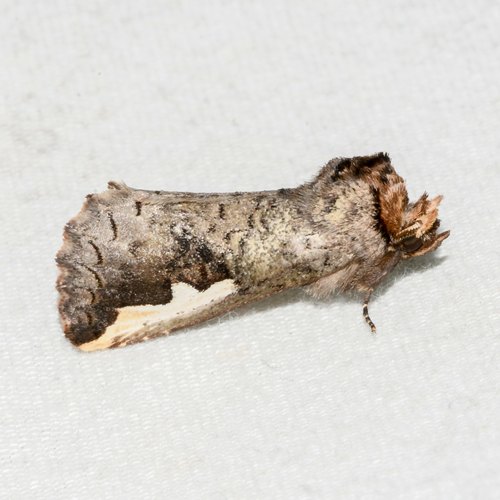
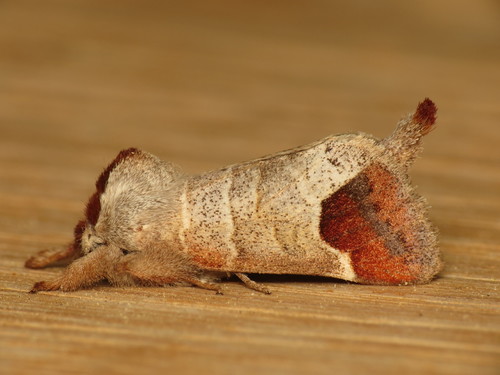
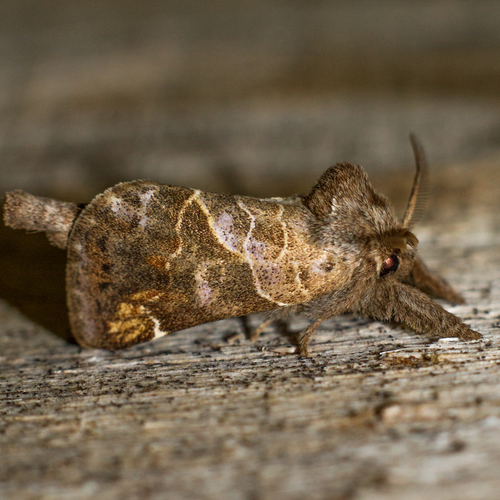
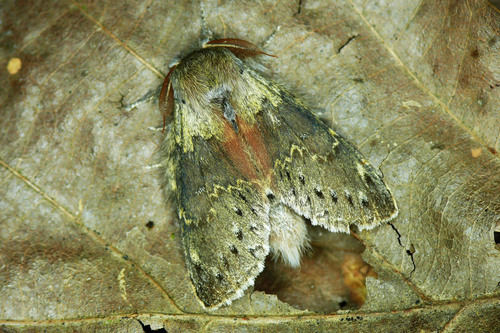
This moth species, Stauropus fagi (Linnaeus, 1758), has a wingspan ranging from 40 to 70 millimetres. Its forewings are grey, grey-brown, or green-brown, with a slightly lighter distal portion. Two bright, jagged crossbands are present on the forewings, and they are often only dimly visible. The midfield section of the forewing, located between these two crossbands, is usually slightly darker. The hindwings share a similar base colour to the forewings but have no markings. In more technical terms, the wings are overall grey-brown. The forewing has a light grey base with a black basal dot; a pale toothed band marks the border of the light basal area, and a second pale toothed band sits in the centre of the wing. Before the wing margin, there is a row of dark submarginal dots edged with white on their proximal side. The hind margin of the forewing is usually red-brown, and the hindwing has some light spots in the centre of its costal margin. The antennae are red-brown, the head and thorax are grey-brown to mouse-grey, and the abdomen is a lighter shade. The underside of the forewing is light grey-brown, while the underside of the hindwing and the underside of the abdomen are light greyish yellow. This species is found across Europe except for its most southern districts, ranging as far south as Portugal, Central Italy and Bulgaria, and northward to Sweden and Livonia. It also occurs in Russia’s Ural region, Armenia, Amurland, and Japan. In Europe, a darker, sharply marked form occurs alongside the typical form; this is aberration obscura Rebel, 1910. The Japanese form, persimilis Butl., now classified as the subspecies S. fagi persimilis Butler, 1879, is somewhat smaller than the nominate true fagi, has more uniformly red-brown colouring, and has a less obvious light basal area on the forewing. The larva is yellowish brown to dark brown, with black longitudinal lines on the tubercles of the three anterior pairs of legs. The lines on the second and third pairs of tubercles continue as oblique lateral stripes down to the stigmata. On the first and second abdominal segments, there is a black spot below the stigmata. On abdominal segments 3 through 6, a narrow black lateral line runs just above the spiracles. Larvae can be found from June through autumn, feeding on beech, oak, lime, hazel, and walnut. In captivity, larvae must always be provided with fresh food and drinking water. They are quarrelsome and biting, and collectors are warned not to keep multiple larvae together, as they will wound each other. Though this behaviour has been denied by some, it has recently been confirmed to occur when larvae are kept in unsuitable conditions. It is very difficult to successfully rear larvae collected when very young, as moulting is especially dangerous for these larvae due to their irregular body shape. The pupa is glossy black-brown, and develops inside a light pale grey cocoon placed between leaves. Moths from early-developing larvae emerge in June or August of the same year. Moths from larvae that pupate at the end of July or later emerge in May or June of the following year. Adult moths are attracted to light. During the day, they rest pressed closely against tree trunks, holding their strongly woolly forelegs stretched forward, in the same posture as Dasychira pudibunda. The species lives throughout the Palearctic realm except for northern Africa; it is absent from Siberia between the Ob' river and Lake Baikal. In Britain, it is more common in the southern counties.