About Stangeria eriopus (Kunze) Baill.
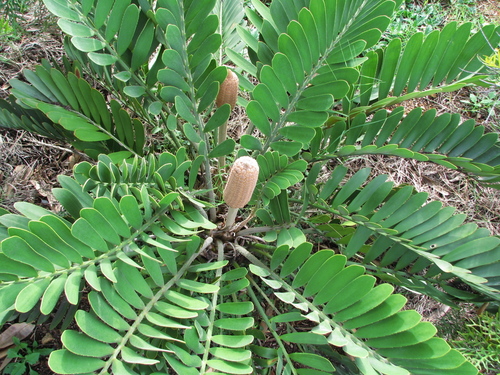
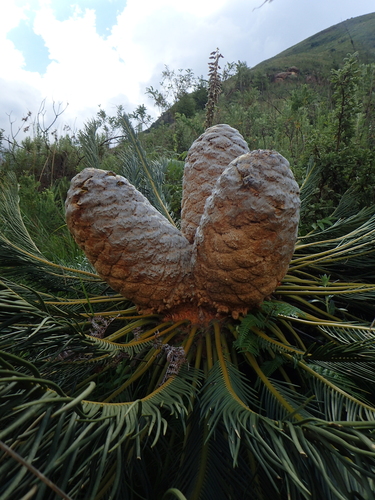
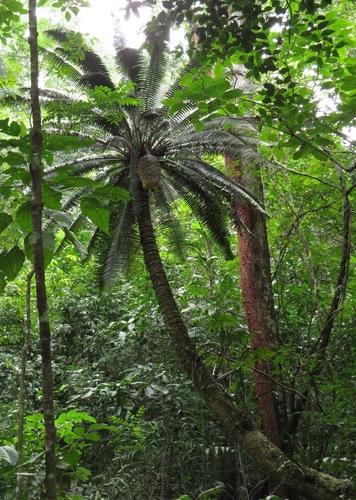
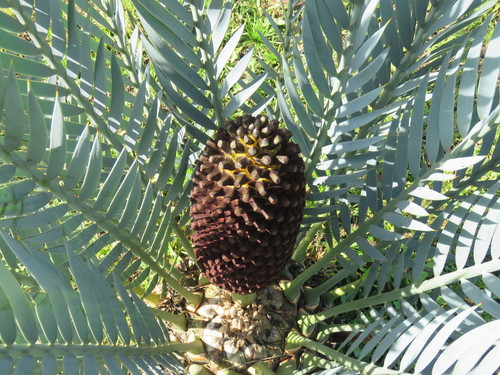
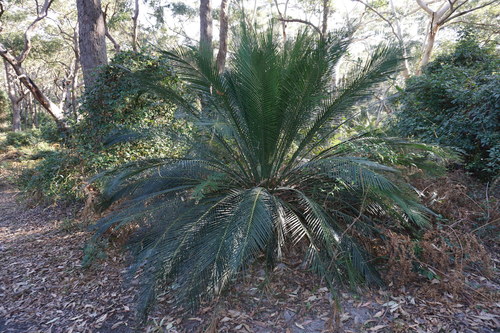
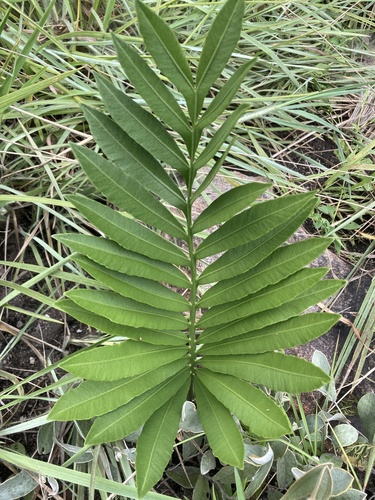
Stangeria eriopus is a very long-lived, perennial, evergreen cycad. It produces stalked, feathered, fern-like leaves between 25 centimeters and 2 meters long. The petiole (leaf stalk) makes up one third to one half of the total leaf length across both of its varieties, and some sources note it can make up half of a leaf’s total length. Its leaves have pinnate veins, a feature that distinguishes this species from all other cycads. Young leaves are bent in bud, with their tips rolled inward. Young leaves are covered in short, gray, unbranched trichomes (leaf hairs), which may be transparent or colored. These trichomes usually fall off quickly, remaining only on the petiole. This species occurs in two distinct variable forms or varieties. The forest variety, which grows in areas with higher rainfall, has large, wide leaves that can reach up to 2 m in length. The grassland variety, which grows in regions that experience annual fire and drought, has shorter leaves with a thicker cuticle that may only reach 30 cm long. This cycad is native to an 800-kilometer narrow coastal strip that falls within the KwaZulu-Cape and Maputaland coastal forest mosaics of South Africa and southern Mozambique. The western edge of its distribution is near Banjul in the Sarah Baartman district. It grows within 50 km of the sea, but does not grow closer than 2 or 3 km to the coast. It is adaptable and can grow in many habitats, ranging from grassland to closed forest, and tolerates both full sun and shade. However, it has low salt tolerance, and is sometimes found in meadows near coastal dunes where it is protected from salt water. It prefers sandy, slightly acidic soil, but at the northern edge of its range, it also grows on clay or very stony soils. In South African traditional medicine, its thickened underground tuberous stem is used to make magical tinctures and as an emetic. Dried tuber is also mixed into cattle feed to treat internal parasites in cattle. Harvesting of wild plants for these uses has been extensive enough to leave the species endangered. In 2005, the market in Mthala paid 5 cents for one gram of this tuber.