About Staheliomyces cinctus E.Fisch.
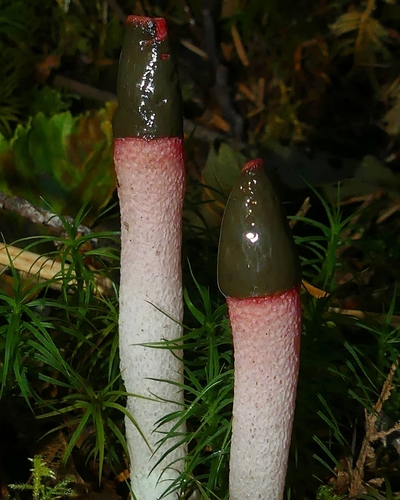
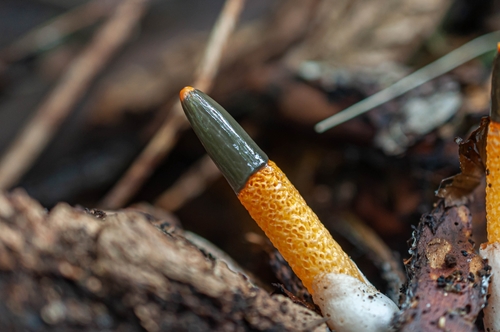
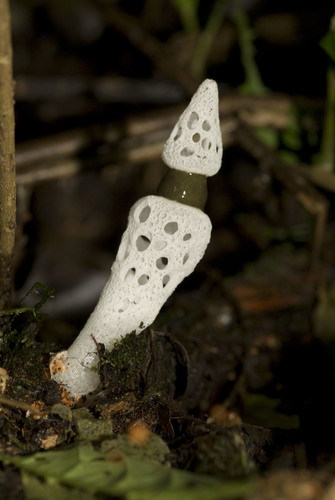
Like all stinkhorns, the fruit body of Staheliomyces cinctus starts developing as a partially submerged "egg" form attached to rhizomorphs. The egg is roughly ovoid, measuring 1.5 to 2 cm (0.6 to 0.8 in) by 1.2 to 1.6 cm (0.5 to 0.6 in). The mature fruit body has a spongy, hollow white stalk that grows 12 to 16 cm (4.7 to 6.3 in) tall. A band of greenish-brown gleba forms a collar around the stalk, positioned above the center but below the apex. This glebal band is narrower than the rest of the stalk, and is between 1 and 2 cm (0.4 and 0.8 in) thick. The cap, also called the receptaculum, sits at the top of the stalk; it is spongy, conical, and chambered, and contains no gleba. A volva is present at the base of the stalk, with rhizomorphs attached to it. The spores are elliptical, hyaline (translucent), and measure 2.5–3 by 1.2–1.5 μm. The edibility of this mushroom is unknown. Staheliomyces is a saprobic genus, and its species typically grow in soil rich with decomposing plant remains. S. cinctus is distributed from southern Mexico to southern Brazil, and its fruit bodies appear during rainy seasons. A field study conducted in Ecuador reported that fruit bodies of Staheliomyces are visited by species from the stingless bee genus Trigona. These bee visits last several minutes, during which bees collect small portions of gleba and store the material in the pollen baskets (corbiculae) on their hind legs. The study authors noted that the corbiculae of approaching bees are always empty. Bee corbiculae are normally used to carry food and nest-building material, and the gleba of Staheliomyces may be used for one of these purposes. The authors did not observe the bees after they collected the gleba.