About Stagonopleura oculata (Quoy & Gaimard, 1830)
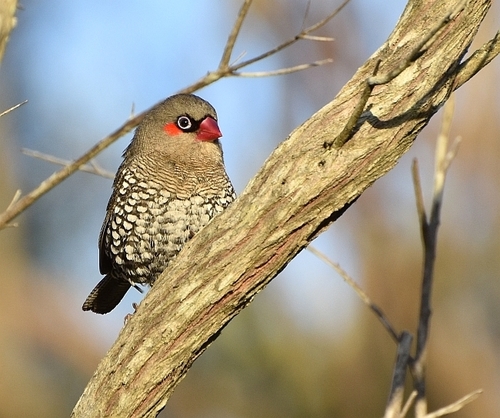
The red-eared firetail (Stagonopleura oculata (Quoy & Gaimard, 1830)) is a small grass-finch with plumage marked by black bars and white spots. It is distinguished by its scarlet bill, black mask, and bright crimson red patch behind the eye and at the rump. Upper body plumage is olive-brown and the breast is buff-brown, both thinly barred black; white spots appear on the blackish underparts. Females closely resemble males, except that male colouring intensifies during the breeding season. Adult plumage is crossed with black vermiculated lines: fine at the nape and crown, and more prominent on scapular feathers, upper-wing coverts, back, and mantle; these sinuous black markings appear on otherwise greyish-brown upperparts. Similar dusky black patterning is finer on the brown throat and cheek, and bolder on the grey-buff foreneck. Underpart feathers (undertail coverts, abdomen, flank) are white with black margins, and barring outlines the distinct spots. The light brown thigh is lightly marked with black crossing. Paler lines cross the brown undertail coverts. Secondary flight feathers and their coverts are also greyish brown with grey-black barring. Primaries and their coverts are dark brown; outer primaries have a thin paler brown margin. A deep crimson shade is visible on the rump and tail coverts. A thin black band extends across the frons, broadening at the lores and circling the eyes to create a masked appearance, which contrasts with the distinctive crimson patch on the ear coverts and the scarlet bill; this mask is comparatively larger in males when closely observed. Tail feathers are dusky brown with fine black barring, and central tail feathers become crimson toward the coverts. Iris colour is recorded as red or dark brown, the eye-ring is pale blue, and legs are dark- or pink-brown. Both sexes have a red bill, with a coating on the male's bill that intensifies its colour during the breeding season. Average adult length is around 125 millimetres (mm). Male weight ranges from 11.4–16.0 grams, while female weight has a narrower range of 12.5–13.6 grams. Based on a sample of thirty males and fifteen females, average measurements for males are: wing 56.2 mm, bill 11.8 mm, tail 43.7 mm, and tarsus 17.0 mm; average female measurements are: wing 56.4 mm, bill 11.6 mm, tail 42.4 mm, and tarsus 17.4 mm. Juvenile plumage resembles adult plumage, but lacks the deep crimson ear patch and spotted belly. In captive individuals, white spots emerge first starting at the flank, with the red ear patch being the last characteristic to develop. Adult vermicular bars are absent from the juvenile nape and crown, and are more subdued across the rest of the upperparts. Black markings at the eyes and lores are absent or nearly absent; the distinct red of the upper tail coverts and rump is duller, and underparts are lighter, buff coloured, and mottled rather than spotted. Immature birds usually gain full adult plumage within four months, although this period is extended if they are born late in the breeding season. The juvenile bill starts brownish black, becoming scarlet between 14 and 22 days after fledging, with blue luminous tubercules visible at the gape. Juvenile legs are a duller brown, and the naked white eye-ring is only faintly blue. The eggshell is pure white, smooth and finely grained, without gloss, with a salmon-pink tone imparted by the egg contents. Alfred North (1901–14) described eggs as 12 mm × 16 mm in size and oval in shape; Forshaw described the form as "ovate to elliptical ovate". Johnstone & Storr (2004) gave average dimensions of 16.6 mm × 12.4 mm from a sample of forty six specimens from nine clutches, with a size range of 15.9–17.8 mm × 11.9–13.2 mm. A clutch of six eggs from Torbay (1959) and another clutch of five from near Albany (1967) were recorded as larger than this average size. The red-eared firetail is an endemic species restricted to the south-western corner of Australia. The species is uncommon to scarce across its range, though it may be locally common in undisturbed locations, which are typically heavy forests and dense heaths near gullies, rivers, and swamps. Population density increases toward the coastal areas of its range, especially the southern coast. The distribution along the southern coast extends east past Esperance. From the southern coast, the species occurs as far north as Cape Naturaliste, Bridgetown, Lake Muir, the Stirling Range, Gairdner River (Calyerup) and the Ravensthorpe Range, and is also found off the coast on Bald and Coffin Islands near the city of Albany. In the Esperance Plains region, the eastern extent of the population reaches Cape Arid National Park, and offshore outcrops of the Recherche Archipelago, such as Middle and Woody Islands. Records are scarcer north of Wungong Brook in the Darling and Stirling ranges, and population density decreases toward the inland regions of Fitzgerald River National Park and Ravensthorpe Range. The firetail is rare in the wheat belt and almost non-existent on the Swan Coastal Plain. The species is thought to breed across its entire distribution range, though breeding has only been recorded at locations west of longitude 120° East. While largely considered sedentary, adults may seasonally relocate outside breeding sites, and immature birds may be pushed to sites where the species is unrecorded during the breeding season. Changes in land use, such as clearing around permanent water frontage, have led to the species disappearing from areas where it was previously recorded. In 1848, twenty years after settlement of the region, Gould described the species as "abundant" around the Swan River colony. By the mid-twentieth century, Serventy noted the species had disappeared from areas near Perth and Pinjarra, and perhaps from the Swan Coastal Plain altogether, though it persisted at gullies around Mundaring Weir in the Darling Range. The 1991 Western Australian Museum Records list the northernmost location as Glen Forrest in the Darling Range, extending to an area near North Bannister and Mount Saddleback, and confirm the species continues to be absent from the Swan Coastal plain. Despite this, there are occasional reports of sightings in this largely cleared region; HANZAB notes two individuals seen at Canning Mills in 1997. A study of the population at Cape Le Gand recorded a population decline between 1944 and 1972. George Masters collected later specimens from the type locality, King George Sound, for the Australian Museum in 1869. In 1921, Tom Carter published a report on the species in the British journal Ibis, noting the species occurred in swamps, was common at paperbark (Melaleuca)-dominated swamps near Albany in 1913, and located nests at a wetland near Cape Leeuwin in 1916; he also recorded occurrences at sites around Lake Muir (1913) and at Warren River (March, 1919) in dense scrub below karri forest. Carter had earlier shared observations between Albany and Cape Naturaliste, noted it was common at springs on limestone hills near Margaret River, Western Australia, and considered a specimen he shot in a karri tree to be outside the species' usual dense understorey habitat. The species is associated with dense vegetation in forest understorey, paperbark swamps, heathland, river frontage, and gullies. Tree species in its wooded habitat include eucalypts such as Eucalyptus marginata (jarrah), Eucalyptus diversicolor (karri) and Corymbia calophylla (marri), as well as Allocasuarina (she-oak), and Melaleuca (paperbark). Its habitat includes riparian vegetation within or adjacent to eucalypt forest, and it is apparently dependent on the nearby presence of a taller forest ecology; the species is noted to disappear when native tree species are replaced by pine plantations. They often occur in locations containing the sedge Lepidosperma tetraquetrum and sheoak species Allocasuarina fraseriana, because the seeds of these plants are a favoured part of their diet. Karri forest is a common habitat, where karri eucalypts are interspersed with stands of jarrah and marri, and the species favours the dense thickets below these giant trees. Trymalium odoratissimum (karri hazel), Allocasuarina decussata (karri oak) and Bossiaea laidlawiana are typical species in these plant associations. The species also occurs in sheoak stands and paperbark swamps within jarrah forests. It also favours marginal habitat dominated by swamp peppermint (Agonis linearifolia), associated with wiry wattle (Acacia extensa), false baeckea (Astartea fascicularis), and karri hazel. The sedge Lepidosperma angustatum occupies the ground storey of these assemblages, along with Acacia mooreana and Hypocalymma angustifolium. Wet heathland habitat includes dense vegetation on kwongan sandplains interspersed with tall shrubs and mallee. Occurrences in dune vegetation systems are recorded in complexes of rushes and sedges with many shrub species, including Olearia axillaris, Boronia alata and Acacia decipiens, in low heathland dominated by Jacksonia horrida. Surveys of earlier study sites in the Darling Range found greater numbers of the species in habitat closer to Wungong Dam than along its tributaries and surrounding valleys. Casual observations are frequently made near carparks at Little Beach, Two Peoples Bay and Porongurup nature reserves, and among the heath of the headland at Cape Naturaliste. Some observations have been made in gardens and parks, along forest tracks, and at roadsides, where the birds may occasionally be killed by traffic. The species occupies a similar ecological niche to Stagonopleura bella, the beautiful firetail, within their respective distribution ranges. The red-eared firetail is a seed-eating estrildid. It is discreet and unusually solitary for an Australian grass finch species. It often remains unobserved in dense vegetation while foraging in the lower storey. Its presence is revealed by its distinctive calls, and the bird is most frequently seen when perched high on the limb of a tree such as marri. Individuals form mated pairs rather than grouping. Each pair's individual range spans around one to two hundred metres across, and they may join other individuals for feeding where their territories overlap. Active site defence only occurs close to the nest, so boundaries between pairs may intersect without incident. Fledglings are eventually fought and driven from the nest site. The conservation status of the species was once listed as rare or of special concern, and its current status is not threatened. It has an estimated global extent of occurrence of 20,000 to 50,000 square kilometres. The species has been affected by large-scale clearing of jarrah forest for pine plantations. The 2016 IUCN Red List classified the species as least concern, citing the 1992 entry in Threatened and Extinct Birds of Australia (Garnett) which notes that while much of its habitat is degraded by salinity or destroyed by changes in agricultural and water management, the species' usually sedentary habits have not prevented it from repopulating suitable habitat. The population is therefore presumed to be stable. Individuals pair in their first year, and this pair bond remains for life. The breeding season runs from October to November, and may extend to January. The nest is carefully and tightly woven from grassy materials, reinforced with green plant tips, forming a rigid spherical structure that faces downward. The red-eared firetail's nest, like that of its sister species the beautiful firetail, is the largest of any Australian grassfinch. Clutches contain between four and six eggs, which hatch after an incubation period of 14 days. Total incubation duty time is equal for each parent. Parents attend to the eggs alternately every one and a half to two hours. Each shift begins with a customary exchange of the intimate nest call between the two parents. When starting his shift, the male may arrive at the nest with a feather, and continues this practice for eight days after the eggs hatch. When the young hatch, both parents remain in the nest for several seconds up to half an hour after a shift change. At night, parents and young huddle tightly together in the nest. Attempts to violently dislodge nesting birds to test their commitment to remaining with their young were unsuccessful. After hatching, eggshells are removed from the nest and dropped 30 to 40 metres away. Young born in aviaries remain in the nest until they fledge, recorded as between two and three weeks, and both parents continue to closely attend to their care and feeding after they emerge. A caged juvenile was observed bathing one week after fledging. Courtship and breeding habits recorded at Immelmann's site in 1960 are supported by later observations and cited in ornithological literature (Storr and Johnstone, 2004; Forshaw and Shephard, 2012, et al.). The male selects a nesting site and performs an overt display, presumed to attract a female: he inflates his posture, gives his identity call, and intersperses this with hopping movements across branches. The male may continue these gestures for up to 45 minutes, often using a 200–450 mm length of grass that appears pierced but is actually held at the bill tip by a fibre pulled from the stalk base. According to Immelmann's ethological interpretation, this grass prop is symbolic of nest construction and copulation, and it dangled downward as the male presents the prospective site. The stem can be lost to high wind as it sways beneath the bill. If the stem becomes snagged on undergrowth while the male moves around the site, he gives a quick sideways tug of his head. If the gestures do not attract a female's interest, the suitor either selects another site or another grass stem before resuming his efforts. When a female responds by investigating the display area, the male abandons his performance, retires to the precise location he proposed, drops his grass stem prop at this position (usually a discreet fork in the branches), and utters his nest site call. If persuaded, the female moves near or onto the position indicated by the male; if dissatisfied, she leaves to wait for the next site proposal. Early reports record nesting sites in prickly Hakea sp. on the coast, and in trees or saplings in forest and woodland regions. In forest, the nesting site is hidden high in a tall tree (marri, jarrah, or yate), or in the branches of mid-storey shrubs such as melaleuca, hakea, or banksia, and amongst creeper or mistletoe. In 1902, Robert Hall observed a nest near Denmark placed between banksia and grasstrees (Xanthorrhoea) over several days. Carter (1921) observed previous season's nests at Cape Leeuwin, where local boys said nests appeared every year; he described these as slightly domed structures made of fibre and fine grasses. This followed a similar earlier report by Carter (published in North, 1914) of a previous season's nest found in September at paperbark swamps near Albany, located ten feet high in tall scrub and "closely resembling those of the chestnut-eared finch" (Taeniopygia guttata castanotis, Australian zebra finch). While he did not make observations during the breeding season at Albany, he estimated the season to be from November to December, and reported seeing fledglings being fed in January 1905 and 1909. Nest construction varies in form: it may resemble a bottle or retort, or be spherical or globular, with a long narrow entrance that often faces downward. External nest dimensions range from 160 to 195 mm in height, 104 to 120 mm in width, and a total length of 220 to 320 mm. Most construction material is fresh grass stems, clipped at the base and held vertically in the male's bill for delivery to the female, who builds the nest. At peak activity, the male delivers one stem every 30 seconds. The interior is lined with feathers and other plant material, and contains a two-part spherical breeding chamber: one chamber is a finer-walled cup-shaped nest. Material on the outer face is often wiry and fibrous, and difficult to prise apart. The interior is generally made of soft green grass. Examination of the elaborate nest construction indicates a significant investment of energy and time for such a small bird. Four nests from the Wungong study site (Immelman, 1960) were found to contain 800 to over 1,000 pieces of material, not counting the lining. The outer parts of each nest contained 400 to 550 strips stripped from twining fringe-lily (Thysanotis patersonii), one measuring 89 cm with fine attached tendrils around 5–35 cm in length. Fringe-lily strips were 40–50 cm long on the structure's exterior, and strips in the tunnels became progressively shorter toward the interior, at around 15–20 cm in length. Tunnels were made of 150 to 180 strips of the same material. The central nest was composed of 230 to 360 soft stems from the grass species Stipa elegantissima, with a maximum length of 20 cm that progressively shortened to 5 cm at the interior. The lining contained over 300 feathers from a dead western rosella (Platycercus icterotis) found nearby, along with large amounts of downy plant material. This brought the total number of items delivered and assembled to over 2000. In 1912, Thomas Burns observed a nest site at Cape Riche, and collected four well-developed eggs on 28 September for an egg collector in New South Wales; these specimens were examined in North's Nests and Eggs of Birds Found Breeding in Australia and Tasmania (1901–14).