About Stagonopleura guttata (Shaw, 1796)
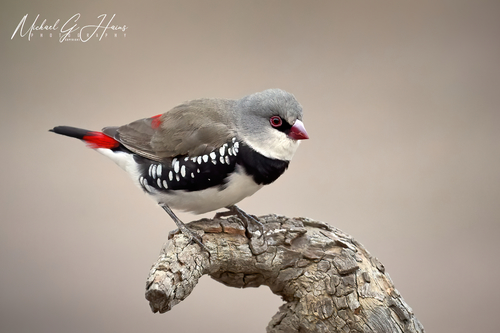
Diamond firetail (scientific name: Stagonopleura guttata (Shaw, 1796)) is one of the largest Australian finches, with a weight range of 15–19 g and a wingspan range of 64–71 mm. eBird describes this species as having an olive back, a grey head, and white belly and throat marked by a complete black band. Its flanks are black with distinct white spots, its rump is bright red (some authors describe this rump color as scarlet), and the tip of its tail is black. Juvenile diamond firetails are duller than adults, have a black bill, and their rump is very noticeable during flight. These birds are typically found in pairs or small flocks, and flocks may sometimes reach up to a hundred individuals. They fly low, in long lines. This species has a patchy distribution stretching from Southeast Queensland to the Eyre Peninsula in South Australia. The Australian Bird Guide places its core distribution from southern Queensland, just north to Inglewood, through Victoria and along the coast to the Eyre Peninsula in South Australia, and eBird maps show a similar distribution. Birdlife Australia reports a broader distribution that extends from the Carnarvon Ranges in Queensland to the Eyre Peninsula and Kangaroo Island; this broader range reflects the species' historic distribution, based on surveys conducted for The Atlas of Australian Birds. In 1917, the species was recorded as far north as the Kirrama Tableland in North Queensland, representing a new record for that district. Diamond firetails are mostly sedentary, and they inhabit open grassy eucalypt forest and woodland, heath, mallee country, farmland, and grassland with scattered trees. Their habitat is threatened by changes to vegetation structure caused by overgrazing, weed invasion, salinisation, and other connected processes. This loss of key food plants and habitat leads to increased competition with invasive species, as well as increased predation. Diamond firetails build their nests from green grass, leaves and stems, and line them with feathers and fine grasses. Nests are placed in dense foliage such as hakeas, rose bushes, boxthorn, and Sea Urchin Hakea, as well as high in trees, including within mistletoe and babblers' nests. This species is also known to build nests inside hawks' nests. Birdlife Australia notes that to protect their eggs and nestlings, diamond firetails often build their nests into the base of large stick nests built by birds of prey, including whistling kites, white-bellied sea-eagles, wedge-tailed eagles, brown falcons, nankeen kestrels, and square-tailed kites. One whistling kite nest was recorded holding nine diamond firetail nests. Both partners share incubation duties and care for the young. Diamond firetails normally lay just one clutch per season, which contains between 4 and 9 eggs.