About Stagonopleura bella (Latham, 1802)
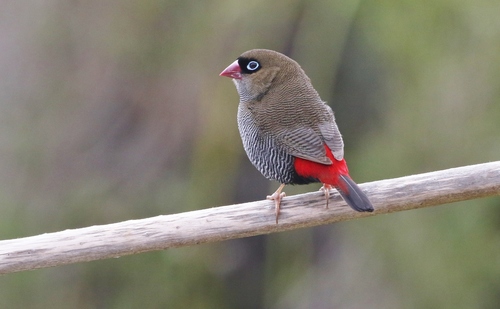
Stagonopleura bella (Latham, 1802), commonly called the beautiful firetail, is a small plump bird. It measures 10 to 13 cm (3.9 to 5.1 in) in length and weighs 14 g (1⁄2 oz), and is slightly smaller than the diamond firetail. Most of its plumage is olive-brown. Its white chest features a fine pattern of dark lines. It has a black mask on the head, pale blue rings around the eyes, and a thick red beak. Its rump is deep red, while its legs and feet are creamy pink. Its wings and tail are short and rounded. Juvenile beautiful firetails are less colourful than adults, with a smaller face mask and a blackish beak. Males of this species have a black abdomen. This bird is endemic to southeastern Australia. Its overall distribution ranges from Newcastle to Kangaroo Island, but it is most abundant in Tasmania and offshore islands. It inhabits coastal heathland, forests, and shrubbery, and is never found far from water. A study of the species in intact forest areas of the Victorian Central Highlands confirmed its preference for habitats near water: it was found almost exclusively in riparian habitat there. The beautiful firetail is a resident bird that stays close to its home range. Its breeding season runs from October to January. During this time, it builds its nest in dense foliage near the ground. The nest is constructed from grass and thin twigs, and its inner surface is lined with feathers. It is bottle-shaped, with a long tunnel-like entrance on one side that leads to a spherical nesting chamber. Both parents work together to build the nest, brood the clutch of five to eight eggs for approximately 20 days, and feed the chicks once they hatch. Chicks leave the nest around 20 days after hatching. They become independent four weeks after fledging, and reach sexual maturity between nine and twelve months of age.