About Stachys sylvatica L.
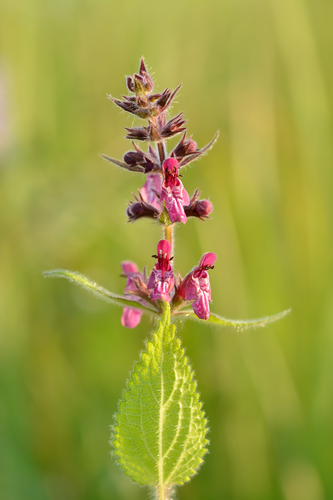
Stachys sylvatica L., commonly called hedge woundwort, is an erect perennial plant that grows slender underground runners. Its stem is squarish and hairy, branches occasionally, and bears glandular hairs on the upper portion of the plant. The nodes along the stem are widely spaced. Its mid-green, stalked leaves grow in opposite pairs. The leaf blades are hairy, with a cordate base, an ovate shape with a blunt tip, and large regular teeth along the margin. The inflorescence forms a dense terminal spike, made up of dense whorls of purple flowers that have white markings. Each flower has a five-lobed calyx, and a two-lipped corolla around 12 to 18 mm (0.47 to 0.71 in) long with a fused tube. The upper lip of each flower is convex and covered in dense glandular hairs, while the lower lip is three-lobed, with the central lobe being the largest. This species has four stamens: two long and two short. Its gynoecium has two fused carpels, and the fruit is a four-chambered schizocarp. Hedge woundwort produces a slightly unpleasant smell. This plant is native to Europe, and central and western Asia. It grows in dappled shade at woodland edges, in hedgerows, and on rough ground. It has been introduced into New York state, Ontario, and New Zealand. Hedge woundwort is popular with bees. Along with its close relatives field woundwort and marsh woundwort, it has been used to promote wound healing, as suggested by the group’s common names. The well-known 17th-century herbalist John Gerard was very impressed with this plant’s healing properties and used it extensively.