About Stachys palustris L.
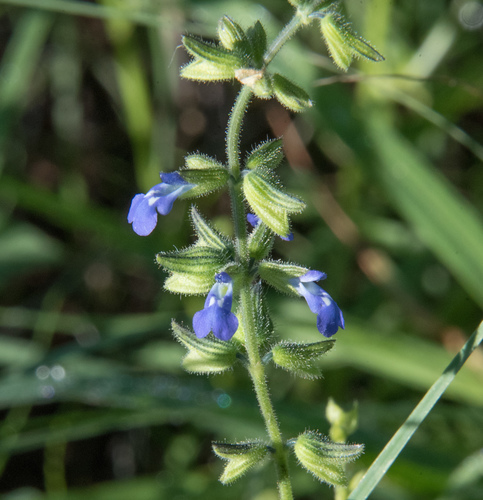
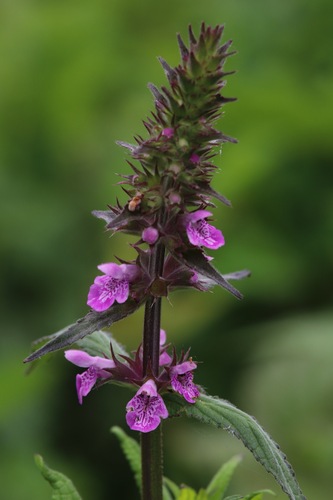
Marsh woundwort, scientifically known as Stachys palustris L., is a perennial plant that grows from a horizontal tuberous runner. It has square stems that bear opposite pairs of leaves; these leaves are nearly stalkless, linearly lanceolate, slightly cordate at the base, and toothed. The calyx features five sharply-pointed lobes. Purplish-red flowers grow in terminal spikes, with noticeable gaps in the lower portion of each spike. Flowers are arranged in whorls, and each individual flower has five fused petals that form a two-lipped corolla: the upper lip is gently hooded, while the lower lip is flat and three-lobed. There are four stamens total, two long and two short, and the fruit produced is a dry, four-chambered schizocarp. Bumblebees are the main visitors to these flowers. This species is native to Europe and Asia. Its typical habitats include lake shores, alder marshes, ditch and stream banks, damp meadows, arable ground, and waste places. In arable land, it is a difficult weed to eradicate due to its persistent tubers. Marsh woundwort has very little fragrance, but remains highly attractive to bumblebees. Nectar indicators guide bumblebees to probe the center of the flower, and the anthers and pistils are positioned correctly to allow the insects to transfer pollen between different plants. The plant’s seeds disperse effectively because its dry fruit capsules float away, which likely explains why it is frequently found along the banks of lakes and other bodies of water. It also spreads vegetatively via hollow tuberous roots, which can produce new shoots far from the original plant. As its common name suggests, marsh woundwort is used alongside its close relatives field woundwort and hedge woundwort to promote wound healing. The word "wort" comes from Middle English, where it means an herb or vegetable.