About Stachys L.
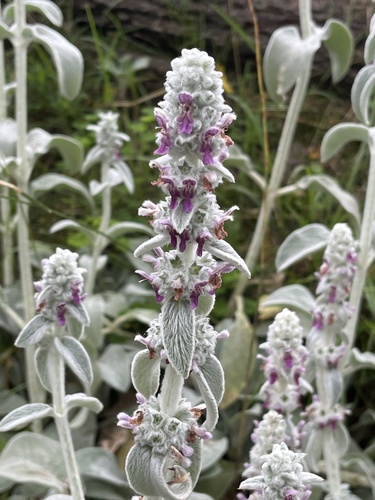
Plants commonly called lamb's-ears, belonging to the genus Stachys L., are herbaceous perennials that are usually densely covered in gray or silver-white silky-lanate hairs. Their common name comes from the curved shape of their leaves and the soft, white, fur-like hair covering the foliage. Their erect, often branched flowering stems are typically 4-angled, and grow 40–80 cm tall. Their leaves are thick and somewhat wrinkled, with both sides densely covered in gray-silver silky-lanate hairs; leaf undersides are more silver-white than upper surfaces. Leaves grow in opposite arrangements along stems, and reach 5 to 10 cm in length. Leaf petioles are semiamplexicaul, meaning their bases wrap halfway around the stem. Basal leaves have oblong-elliptic blades that measure around 10 cm long and 2.5 cm wide, though cultivated forms show variation in size. Leaf margins are crenulate, but are covered in dense hairs; leaf apexes are attenuate, gradually narrowing to a rounded point. Lamb's-ear is commonly grown in children's gardens, because it is easy to cultivate and its thick, felt-like leaves are pleasant to touch. It is also used as an edging plant. In Brazil, it is grown as an edible herb under the local name peixinho-da-horta, where it is prepared by being battered, deep-fried, and sprinkled with lemon juice; it is said to have a fish-like taste. It has sometimes been used as a medicinal plant. A number of cultivars exist, including white-flowering forms, shorter plants, and plants that bloom less heavily: 'Big Ears' has very large leaves that can reach 30 cm (1 foot) long. 'Cotton Boll' is a sterile cultivar that does not produce flowering stems, and is propagated asexually. 'Primrose Heron' has yellow leaves in spring and pink flowers. 'Sheila Macqueen' is a low-growing sterile cultivar with large leaves. 'Silky Fleece' grows 25 cm tall and produces lilac-plum flowers, with smaller white-woolly foliage, and is propagated from seed. 'Silver Carpet' is a sterile cultivar with grey leaves, propagated asexually. 'Striped Phantom' has variegated leaves. Lamb's-ear attracts many types of insects and hummingbirds, and is especially popular with bees. A special bee species, the wool carder bee, collects fuzz from the plant's leaves to use in building nests in decayed wood. Bumble bees have been observed gathering on the leaves in the morning to collect water condensation that accumulates on the foliage. Stachys byzantina extract has demonstrated antimicrobial activity against vancomycin-resistant Staphylococcus aureus. Because it has a relatively high rate of evapotranspiration, Stachys byzantina may be a useful species for retaining rainwater, and thus for flood prevention.