About Stachys bolusii Skan
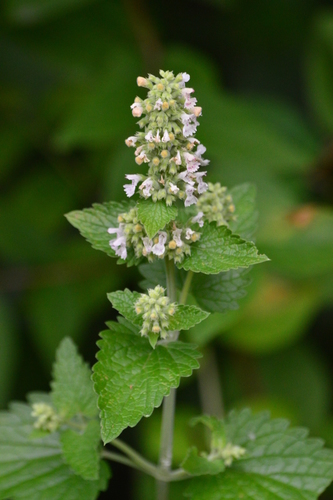
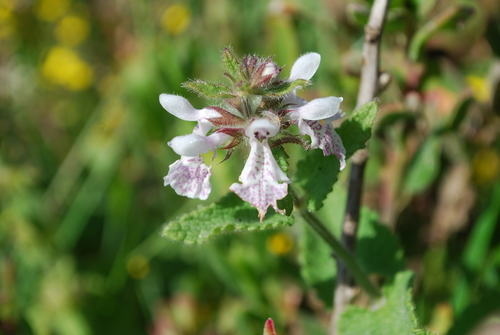
Stachys bolusii Skan is a perennial herb. It has spreading to ascending, branched stems that grow up to 0.45 m (1 ft 6 in) long. Stems have a sparse to fairly dense covering of long spreading to backward-pointing hairs, and also have some gland-tipped hairs. Its leaves grow on stalks and have broadly ovate blades; the larger leaves measure 30–55 mm (1.2–2.2 in) long. Both leaf surfaces are fairly densely hairy; leaves have blunt to rounded tips and deeply heart-shaped bases. Leaf margins are regularly and somewhat coarsely scalloped, with roughly 10 to 14 rounded teeth on each side. The inflorescence is simple, scarcely tapering, and reaches up to 150 mm (5.9 in) long. It is made of several whorls, each holding six flowers. The bracts are densely hairy and leaf-like, particularly the lower bracts; they get smaller toward the top of the inflorescence but remain longer than the corolla. Flowers are nearly stalkless. The calyx is densely hairy and measures around 7 mm (0.28 in) long. The corolla is white, with purple or pink markings on its lower lip; it has a short tube, an ascending upper lip, and a downward-curving lower lip. This species blooms from August to September. At one time it was considered rare, likely because it has frequently been confused with the highly variable Stachys aethiopica, which overlaps with it across most of its geographic range. The key identifying difference between the two species is the length of floral bracts: in Stachys bolusii, the bracts are longer than the corolla, while in Stachys aethiopica, the bracts are shorter than or equal in length to the calyx. Stachys bolusii grows among rocks in the greater Malmesbury area, and along the coast from Saldanha to the Cape Peninsula. Some sources note its range extends to Stanford.