About Squilla mantis (Linnaeus, 1758)
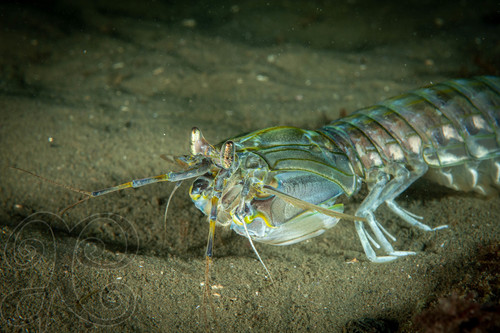
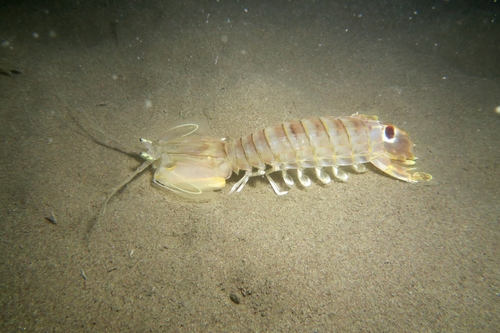
Spot-tail mantis shrimp (Squilla mantis) individuals grow up to 200 millimetres (8 inches) long. This is a spearer type mantis shrimp, distinguished by forelimbs modified into spiked, elongated "spears" that it uses to capture soft-bodied prey. Its body is generally dull brown, and it has two white-circled brown eye spots at the base of the telson. Other mantis shrimp species, including smasher types, are often mis-sold in the aquarium trade under the name Squilla mantis. This species is found along the entire coast of the Mediterranean Sea, and in the Atlantic Ocean from the Gulf of Cádiz south to Angola, as well as around the Canary Islands and Madeira. Historically, it was recorded in Galicia, the Bay of Biscay, and the British Isles, but there are no recent confirmed records of the species occurring in these areas. It is especially abundant on sandy and muddy bottoms with strong river run-off, where the substrate allows burrowing. In the Mediterranean, these habitat conditions are found near the outflows of the Nile, Po, Ebro and Rhône rivers. Spot-tail mantis shrimp are most commonly found at depths up to 150 metres (490 ft), with the highest population densities typically occurring between 50 and 60 metres (160 to 200 ft). Sporadic individuals have been recorded in much deeper water, reaching a maximum recorded depth of 367 metres (1,204 ft). Squilla mantis digs burrows in sandy and muddy substrates near coastlines. It stays inside its burrow during the day, emerging at night to hunt, and emerging in winter to mate. Feeding activity is strongly tied to nighttime, and captive individuals usually refuse to eat during the day. Adult spot-tail mantis shrimp are strongly sedentary. The alpheid shrimp Athanas amazone often lives inside the burrows of S. mantis, even though it is similar in size to other shrimp that S. mantis preys on. The ecological relationship between these two species is still unknown, though a similar association has been documented between Athanas squillophilus and burrows of Oratosquilla oratoria in Japanese waters. Spot-tail mantis shrimp are opportunistic predators and scavengers, feeding on a range of food sources based on local availability. Common food items include other crustaceans such as crabs and decapods, mollusks such as bivalves and squid, polychaetes, benthic fishes, algae, and other prey. This species has been observed following fishing boats to feed on discarded dead animals. S. mantis shows cannibalistic tendencies, and digestive tracts of individuals have been found to contain conspecific remains. Mantis shrimp have also been recorded feeding on the egg masses of common cuttlefish. The reproductive season of S. mantis falls in winter and spring. Gonad maturity peaks in April in the Ligurian Sea, while in the Adriatic Sea the peak occurs between February and March. After laying eggs, females attach their eggs to their anterior legs using a sticky secretion produced by cement glands located in their sternums. They then incubate the eggs through spring and early summer, and do not leave their burrows or feed during this incubation period. Eggs hatch between late spring and late summer. The planktonic larvae, called alima, stay in the water column through summer and early autumn. Larval numbers peak in August, though some larvae can still be found as late as November. After going through ten aquatic molts, the larvae settle onto the seabed and grow to adult size over the rest of the year. Females typically spawn for the first time within their second year. Most S. mantis only spawn once in their lifetime, though some individuals survive to reach three years of age.