About Squilla empusa Say, 1818
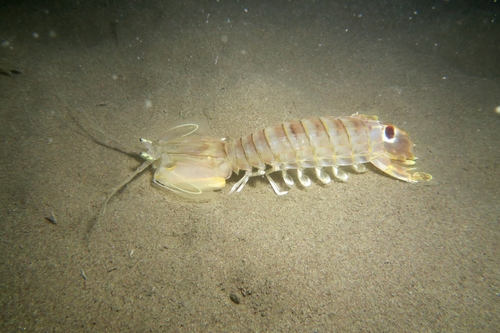
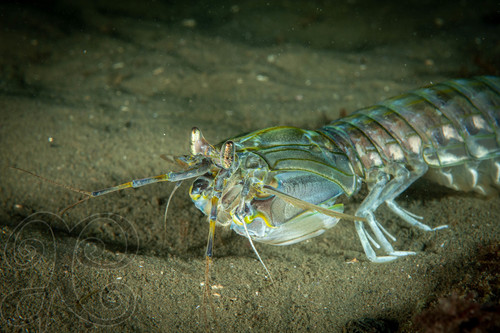
Squilla empusa Say, 1818 grows to a length of about 30 cm (12 in). Its head bears stalked compound eyes that can move separately to scan the surroundings. The head and thorax are fused into a cephalothorax, which is protected by a shield-like carapace. The thorax has eight segments, each with a pair of appendages. The first pair of these appendages are slender and used for grooming, while the second pair are large, raptorial claws that can slash and spear prey. The third, fourth and fifth pairs each have a flattened terminal segment; these are called maxillipeds, and they are used to move food to the mouth. The sixth, seventh and eighth pairs are unspecialised walking legs called pereiopods. The abdomen has six segments. The front five each bear a pair of pleopods (swimming legs). These are biramous (branched) and carry filamentous gills. The sixth segment has a pair of large uropods that, together with the flexible, six-spiked telson, form a broad tailfan. Squilla empusa has been recorded from the eastern seaboard of the United States, with a range extending from Cape Cod to the Gulf of Mexico. It has also been reported from Brazil and the Mediterranean Sea. It lives in a U-shaped burrow in soft sediment on the seabed, at depths from the intertidal zone down to about 150 m (500 ft).