About Squatina squatina (Linnaeus, 1758)
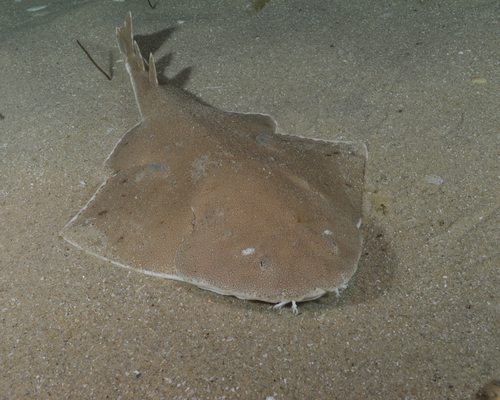
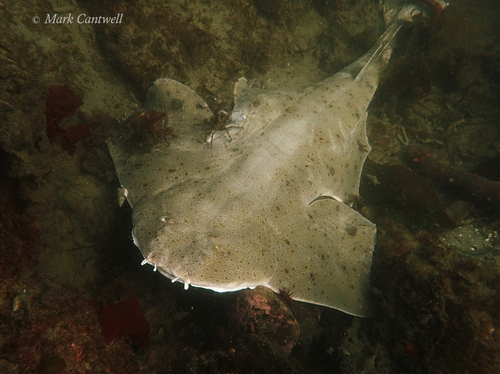
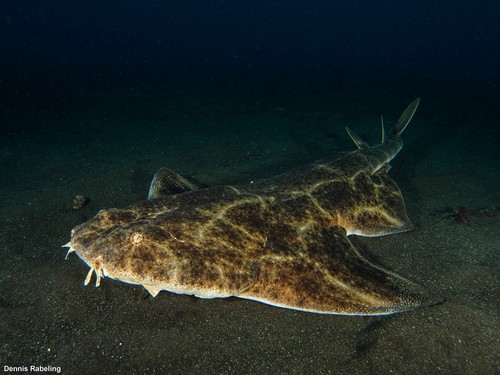
Squatina squatina, commonly called the angelshark, is one of the largest species in its family. Females can reach a length of 2.4 m (7.9 ft), while males reach 1.8 m (5.9 ft); the maximum recorded weight for the species is 80 kg (180 lb). Like all other angelsharks, it has a flattened body and large wing-like pectoral fins, whose anterior lobes are not fused to the head. Its head and body are very broad and stocky, with small eyes placed on the dorsal side, and a pair of larger spiracles directly behind the eyes. In front of the nares there is a pair of plain barbels, along with a smooth or weakly fringed flap. Folds of skin with a single triangular lobe are present on the sides of the head. Its teeth are small, sharp, and similar in shape in both the upper and lower jaws. The pectoral and pelvic fins are wide with rounded tips, and two dorsal fins sit on the muscular tail behind the pelvic fins. This species lacks an anal fin, and its caudal fin has a larger lower lobe than upper lobe. Small, narrow, pointed dermal denticles cover the entire upper body surface and most of the lower body surface. Patches of small spines are found on the snout and over the eyes, and small individuals have a row of thorns running down the middle of the back. The species is gray to reddish or greenish brown on its upper side, marked with many small black and white spots, and white on its lower side. Juveniles have more elaborate patterning than adults, with pale lines and darker blotches. The dorsal fins have a darker leading margin and a lighter trailing margin, and some individuals have a distinct white spot on the back of the "neck". This angelshark lives in temperate waters of the northeastern Atlantic Ocean, ranging from southern Norway and Sweden south to Western Sahara and the Canary Islands; its range also includes waters around Ireland and Britain, and the entire Mediterranean Sea. The IUCN notes the species may already be extirpated from the North Sea. Confirmed extant populations remain around the Canary Islands, Algeria, Tunisia, Libya, Palestine, Turkey, northern Cyprus, eastern Greece's Aegean Sea, the Adriatic Sea off eastern Italy, Sicily, Malta, Corsica, Ireland, and western Britain/Wales. Its current presence is unknown in many parts of its former range, including around Madeira, the Azores, Morocco, Egypt, continental Spain and France, Crete, Syria, Sardinia, western Greece, and western Italy. This is a benthic shark that lives on the continental shelf, and prefers soft substrates such as mud or sand. It can be found from near the coast down to a depth of 150 m (490 ft), and it sometimes enters brackish environments. Northern subpopulations of this angelshark migrate northward in summer and southward in winter. During the day, the angelshark usually stays motionless on the seabed, buried under sediment with only its eyes visible. It becomes more active at night, and may sometimes swim above the sea floor. In summer, aggregations of up to one hundred angelsharks have been recorded off Gran Canaria. The angelshark is an ambush predator that feeds primarily on bottom-dwelling bony fishes, especially flatfishes. It also preys on skates and invertebrates. Documented prey items include the hake Merluccius merluccius, the bream Pagellus erythrinus, grunts of the genus Pomadasys, flatfishes Bothus spp., Citharus linguatula, and Solea solea, the squid Loligo vulgaris, cuttlefishes Sepia officinalis and Sepiola spp., and crabs Medorippe lanata, Geryon trispinosus, Dromia personata, Goneplax rhomboides, Liocarcinus corrugatus, and Atelecyclus rotundatus. Seagrass and birds (including one record of an entire cormorant) have also been found in the stomachs of examined specimens. Individual angelsharks choose sites that give them the best ambush opportunities, and will remain at successful sites for several days. Angelsharks are aplacental viviparous: young hatch inside the mother's uterus and are nourished by a yolk sac until birth. Females have two functional ovaries, with the right ovary holding more oocytes, and the right uterus correspondingly holding more embryos; this functional asymmetry does not occur in other angel shark species. Unlike most sharks, where yolk formation (vitellogenesis) happens at the same time as pregnancy, vitellogenesis in this angelshark does not start until halfway through the gestation period. Mature ova measure 8 cm (3.1 in) across and are not enclosed in a capsule. The reproductive cycle is estimated to be 2 years long, with ovulation occurring in spring, though this timeline is not clearly defined. Litter sizes range from 7 to 25 pups, and litter size correlates with the mother's body size. Gestation lasts 8 to 10 months. In the Mediterranean, birth occurs from December to February, while off England parturition happens in July. Newborn angelsharks measure 24 to 30 cm (9.4 to 11.8 in) long. Males mature at lengths of 0.8–1.3 m (2.6–4.3 ft), while females mature at 1.3–1.7 m (4.3–5.6 ft). Documented predators of Squatina squatina include the roughtail stingray Bathytoshia centroura, and possibly the sand devil Squatina dumerili, which is thought to only prey on juvenile angelsharks. The first recorded interaction with S. dumerili happened in 2024 off Los Terresitas Beach, Tenerife, Canary Islands: in this incident, a roughtail stingray attempted but failed to prey on a juvenile S. squatina, after which the S. squatina individual was captured by the sand devil. Known parasites of this species include the tapeworms Grillotia smaris-gora, G. angeli, and Christianella minuta, the fluke Pseudocotyle squatinae, the monogenean Leptocotyle minor, and the isopod Aega rosacea.