About Squatina californica Ayres, 1859
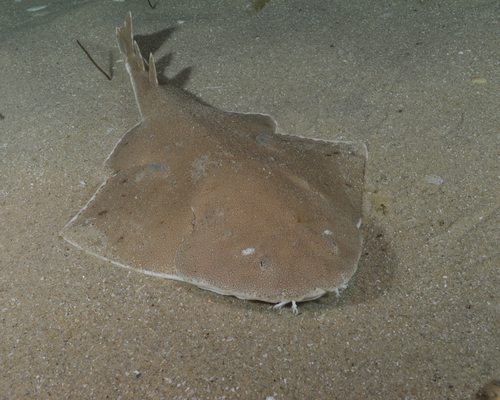
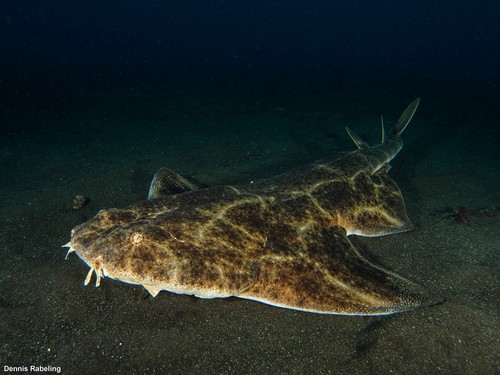
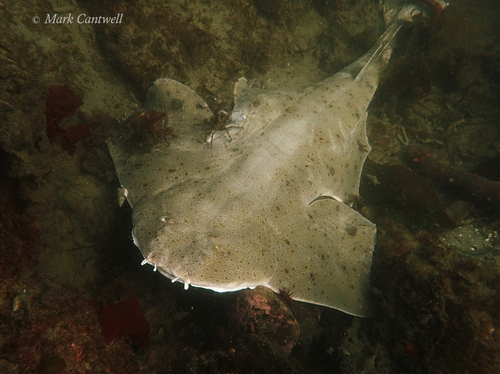
Squatina californica Ayres, 1859, commonly called the Pacific angelshark, has a flattened body and wing-like pectoral fins that make it superficially resemble a ray. It can be distinguished from rays by several traits: its five pairs of gill slits sit on the sides of the head rather than underneath, and the expanded anterior lobes of its pectoral fins are separate from the head instead of fused to it. The shark's eyes sit on top of the head, with spiracles located behind them, and folds of skin without triangular lobes run along the sides of its head. Its mouth is very wide and positioned terminally, at the front of the snout, with a pair of cone-shaped barbels that have spoon-like tips located above the mouth. There are 9 tooth rows on each side of the upper jaw and 10 tooth rows on each side of the lower jaw, with toothless gaps at the middle of both jaws. Each tooth has a broad base and a single narrow, smooth-edged cusp. Pacific angelsharks have broad, angular pectoral and pelvic fins with pointed tips. Their two dorsal fins are located far back on the body, and they have no anal fin. The lower lobe of their caudal fin is larger than the upper lobe. A row of small thorns runs down the middle of the back and tail; thorns are also present on the snout and over the eyes. As the shark ages, these thorns decrease in size and may disappear entirely. The species' dorsal coloration is gray, brown, or reddish brown with scattered dark markings: adults have large blotches surrounded by a ring of tiny spots, while juveniles have pairs of ocelli. The underside is white, and this white color extends to the margins of the pectoral and pelvic fins. This species reaches a maximum length of 1.5 m (59 in) and a maximum weight of 27 kg (60 lb), though it has been recorded growing up to 175 cm (68.9 in) long, with newborns measuring around 25 cm (9.8 in) long at birth. It occurs from the surf zone down to a depth of 205 m (672 ft). Verified records place Pacific angelsharks from Clover Point, Vancouver Island, south to southern Baja California, the Gulf of California, and Peru. There are also unconfirmed reports of the species from southeastern Alaska and Chile. It is common from Tomales Bay, northern California, southward. More broadly, Pacific angelsharks inhabit cold to warm-temperate waters from the southeastern corner of Alaska to the Gulf of California, including the entire Baja peninsula, and are most common off central and southern California. They may also occur from Ecuador to the southern tip of Chile, though this range includes taxonomic uncertainty. A bottom-dwelling shark, the Pacific angelshark prefers habitats with soft, flat bottoms close to shore, such as estuaries and bays, and is often found near rocky reefs, submarine canyons, and kelp forests. On occasion, individuals have been observed swimming 15–91 m (49–299 ft) above the sea floor. Off California, the Pacific angelshark is most common at depths of 3–45 m (9.8–147.6 ft), but has been reported as deep as 205 m (673 ft). Multiple genetically distinct subpopulations have been identified across the northern range of the Pacific angelshark. Several subpopulations exist along the coast from Point Conception northward to Alaska. In the Southern California Bight, there are at least three separate subpopulations off the mainland and the northern and southern Channel Islands. The subpopulation along the Pacific coast of Baja California is distinct from those in the Gulf of California. These subpopulations have diverged from one another over time because Pacific angelsharks do not make long migratory movements outside their preferred home areas, and deep waters act as effective geographical barriers that prevent population mixing. Genetic diversity, measured by heterozygosity, is higher in the Pacific angelshark than in other shark species that have been studied. In terms of biology and ecology, Pacific angelsharks are almost never seen out in the open during the day; instead, they rest motionless on the sea floor buried under a thin layer of sediment that hides their outline. At night, some individuals remain motionless waiting for prey, while others are found unburied on the bottom or actively swimming. Large sharks including the great white shark (Carcharodon carcharias) and the broadnose sevengill shark (Notorynchus cepedianus), along with the northern elephant seal (Mirounga angustirostris), are known to prey on Pacific angelsharks. Documented parasites of this species include the copepod Trebius latifurcatus, which infests the skin; the myxosporidian Chloromyxum levigatum, which infests the gall bladder; and the tapeworm Paraberrapex manifestus, which infests the spiral valve intestine. The leech Branchellion lobata may attach around this shark's cloaca, inside the intestine, and even inside the uterus and on developing embryos. The Pacific angelshark is aplacental viviparous, meaning unborn young are nourished by a yolk sac inside the mother, and reproduction follows an annual cycle. Most females have a single functional ovary, on the left side, though some have two; the oviducts are often filled with yolk, which is speculated to come from the resorption of unfertilized eggs. Young embryos that measure 35 mm (1.4 in) long have translucent skin, protruding eyes, and exposed gill filaments. Spots of pigment have developed when the embryo reaches 70 mm (2.8 in) long, and the first row of teeth has appeared when the embryo is 110 mm (4.3 in) long. By the time the embryo is 150 mm (5.9 in) long, the mouth has migrated to its terminal position and the full color pattern has developed; the external yolk sac begins to shrink as yolk is transferred to an internal yolk sac, where it is held until it can be moved to the intestine for digestion. The internal yolk sac is fully resorbed before birth; if a pup is released prematurely, it will not feed until this process is complete. Off Santa Barbara, birthing occurs from March to June after a ten-month gestation period, and females mate again shortly after giving birth. The average litter size is six, with a typical range of 1–11 (and 13 occurring rarely); there is no correlation between female size and the number of offspring. Young are born in water 55–90 m (180–295 ft) deep, probably to protect them from predators. Young Pacific angelshark embryos grow at 45 mm (1.8 in) per month, and this growth slows to 10 mm (0.39 in) per month just before birth. Pups are born at a length of 25–26 cm (9.8–10.2 in). Newborn pups in captivity grow at a rate of around 14 cm (5.5 in) per year, while wild adults grow at around 2 cm (0.79 in) per year. Both sexes mature when they reach 90–100 cm (3.0–3.3 ft) long, which corresponds to an age of 8–13 years. Sharks from the Gulf of California, which may represent a separate species, mature at 78 cm (2.56 ft) long for males and 85 cm (2.79 ft) long for females. About 20% of newborns survive to reach maturity. The maximum lifespan has been estimated at 25–35 years. Unlike most other sharks, growth rings on the vertebrae of this species are deposited in proportion to the shark's size rather than once per year, which makes age determination difficult.