About Squalus suckleyi (Girard, 1855)
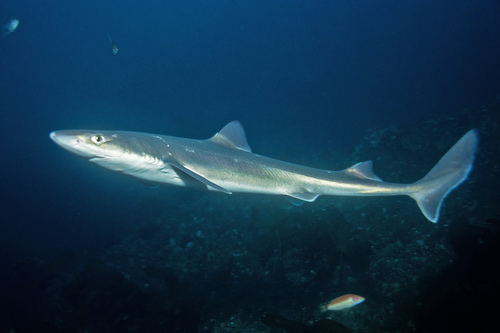
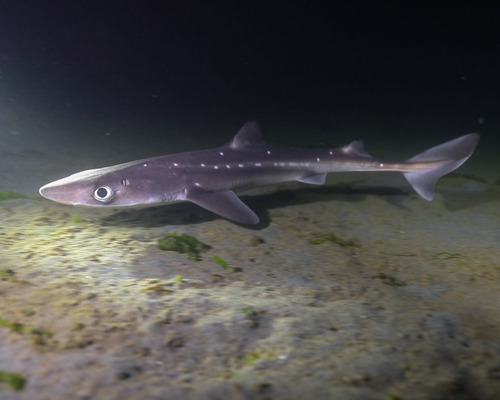
The Pacific spiny dogfish, with the scientific name Squalus suckleyi, is a common shark species in the Squalidae (dogfish) family, and is among the most abundant shark species in the world. This species is closely related to the spiny dogfish, and for many years the two were treated as a single species. Recent research using meristic, morphological, and molecular data has led to the resurrection of the Pacific spiny dogfish as a separate species. The American Fisheries Society recommends the common name "Pacific spiny dogfish" for Squalus suckleyi over alternative common names such as "spotted spiny dogfish" and "North Pacific spiny dogfish", and reserves the name "spiny dogfish" for Squalus acanthias.
The maximum recorded length of a Pacific spiny dogfish is 130 centimetres (51 in), and the species can live up to 100 years. Compared to Squalus acanthias, Squalus suckleyi has a slower growth rate, a larger maximum body size, and reaches sexual maturity later. Its slower growth and later maturity may be linked to the colder temperatures the species experiences. Pacific spiny dogfish prefer water temperatures between 7 and 15 °C (45 to 59 °F). While dogfish as a group are found worldwide, Pacific spiny dogfish are found mostly in the North Pacific Ocean, ranging from Korea to Japan and Russia, and from the Gulf of Alaska down to Baja California. This species is piscivorous, feeding on other fish, and also consumes octopus, squid, and crustaceans.
Squalus suckleyi has a slower reproduction rate than most other sharks, with a gestation period of roughly two years. This slow reproduction makes the species more vulnerable to threats, as it takes longer to rebuild populations.
The natural habitat of Pacific spiny dogfish includes bays, as well as inshore and offshore waters. Females are most often found in inshore waters, while young pups are typically found moving through offshore waters. The species is most commonly found on the sea floor along the continental shelf. Pacific spiny dogfish primarily live in saltwater, but can tolerate and survive in brackish water, a mix of salt and fresh water.
Pacific spiny dogfish share the same reproductive characteristics as Squalus acanthias, but have an overall slower reproductive rate. The total gestation period ranges from 18 to 24 months, and dogfish living in cooler water often have longer pregnancy durations. As pregnancy progresses, females migrate from deep water to shallow water, and this migration pattern affects embryonic growth. For example, pups near Newfoundland grow an average of 1.1 cm per month over a 24-month pregnancy, while those in the warmer waters off Massachusetts grow an average of 1.3 cm per month over a 20 to 22-month pregnancy.
The age at which Pacific spiny dogfish reach sexual maturity is difficult to determine, as it varies widely from 10 to 30 years. Food availability and water temperature both influence the growth and development of the species. Newborn Pacific spiny dogfish measure around 22 to 23 centimeters in length. Females are significantly larger than males at all mature stages: at sexual maturity, males measure 60 to 70 cm, while females measure 70 to 100 cm. This size difference is tied to female reproduction, as larger bodies are required to carry and protect eggs inside the body. Pacific spiny dogfish are ovoviviparous, meaning their eggs develop and hatch inside the mother's body. Litter sizes range from 1 to 20 newborn pups. Fertilization typically occurs between the beginning of October and the beginning of February.