About Squalus acanthias Linnaeus, 1758
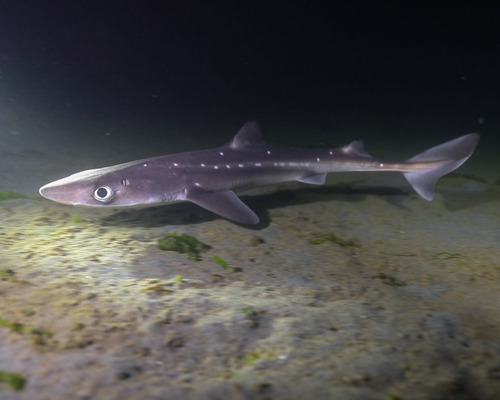
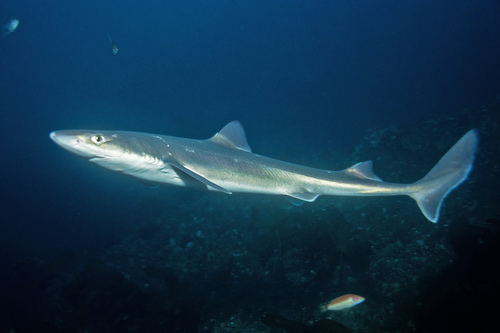
Description and behaviour: The spiny dogfish has dorsal fins, no anal fin, and white spots along its back. Its caudal fin has asymmetrical lobes, forming a heterocercal tail. The species epithet acanthias refers to the shark's two defensive spines. If captured, the shark can arch its back to pierce its captor with the spines located near its dorsal fins; these spines secrete a mild venom into the attacker. This shark is known to hunt in packs that can number in the thousands. It is an aggressive hunter with a broad diet that includes squid, fish, crab, jellyfish, sea cucumber, shrimp, and other invertebrates. Spiny dogfish have one of the longest gestation periods of any organism, lasting between 18 to 24 months. Spawning occurs during the colder winter months, where females produce 2 to 12 eggs that develop ovoviviparously, resulting in live birth of pups. Litters typically contain 5 to 6 pups, with litter size mostly depending on the size of the female. Reproduction takes place in winter in offshore waters, while pups are normally born in warmer, deeper offshore waters that are hard for humans and other predators to access. The reproductive cycle begins when females produce several large yellow eggs. The eggs become fertilized after passing through the shell gland, and are wrapped in a reproductive capsule called a "candle". Fertilization can be confirmed by the presence of a blastoderm on the egg. The candle travels through the rest of the female's reproductive tract until it reaches the uterus. A yolk sac attached to the pup's gill region provides nutrients during development, and the pup absorbs the yolk sac as it grows. Even after fully absorbing the yolk sac, pups may remain in the uterus for additional time during the gestation period. Both sexes are greyish brown in color and have countershading. Males are recognizable by a pair of pelvic fins modified into sperm-transfer organs called claspers; during copulation, the male inserts one clasper into the female's cloaca. In females, sexual maturity is determined by the size of ova and the condition of the uteri. In males, maturity is determined by clasper length and calcification. Most growth follows an isometric pattern, meaning pups have nearly identical features to adults. Sexual maturity does not align with overall body size development, as sharks mature earlier than would be expected. Most males reach sexual maturity around 10 years of age, when they grow to 60–65 cm in length. Females take longer to mature, reaching sexual maturity around 16 years of age at a length of 80–84 cm. Some spiny dogfish have been recorded living nearly 70 years, with an average lifespan of 30–40 years; lifespan estimates from analysis of vertebral centra and annuli in the dorsal spines range from 35 to 54 years. Before reaching sexual maturity, male claspers are longer than the pelvic fins, while the testes develop, but do not produce sperm, and the genital ducts are deformed compared to those of mature adults. Once sexually mature, claspers are elongated, hardened with calcium, and still slightly longer than the pelvic fins. At this stage, testes are fully developed, sperm is present in the seminal vesicles, and genital ducts take the twisted shape typical of adult sharks. Spiny dogfish are bottom-dwellers. They are most commonly found at depths between 50–149 m, but have been found deeper than 700 m. Fossil range: Fossils of Squalus acanthias are known from the Miocene of Denmark and the Netherlands, dating to approximately 11 million years ago. Like other cartilaginous fish, the fossil record of Squalus acanthias is made up mostly of dental material, because cartilage does not fossilize well. The teeth of S. acanthias can be hard to tell apart from the teeth of other squaliform sharks, making fossil identification difficult. Commercial use: Spiny dogfish are sold as food in Europe, the United States, Canada, New Zealand, Venezuela and Chile. Its meat is primarily eaten in England, France, Italy, the Benelux countries, and Germany; in Greece, it is often sold unknowingly as houndshark. In England, dogfish is sold at fish and chip shops as "huss", and was previously sold as "rock salmon" until the term was outlawed. Commercial harvests of spiny dogfish were banned in the UK from 2010 to 2023. In France, it is sold as "small salmon" (saumonette), and in Belgium and Germany it is sold as "sea eel" (zeepaling and Seeaal, respectively). In Greece, all small dogfish are commercially called galéos, named after the critically endangered Galeorhinus galeus used for a traditional seasonal dish; spiny dogfish and other small sharks are often substituted for it. Whole spiny dogfish are processed into fertilizer, liver oil, and pet food. Due to their wide availability, cartilaginous skulls, and small size, they are common vertebrate dissection specimens used in high schools and universities. Reported global catches of spiny dogfish ranged from 31,700 tonnes in 2000 to 13,800 tonnes in 2008. They are primarily caught using bottom trawlers and sink gillnets. In Mid-Atlantic and Southern New England fisheries, they are often caught alongside larger groundfish, classified as bycatch, and discarded. Recreational fishing makes up an insignificant portion of the total spiny dogfish catch. As of 2017, the Cape Cod Commercial Fishermen's Alliance, funded by the National Oceanographic and Atmospheric Administration, has promoted sustainable use of spiny dogfish in restaurants and fish markets around Cape Cod, Massachusetts. The initiative aims to encourage diners to purchase less commonly consumed fish like spiny dogfish.