About Squalius cephalus (Linnaeus, 1758)
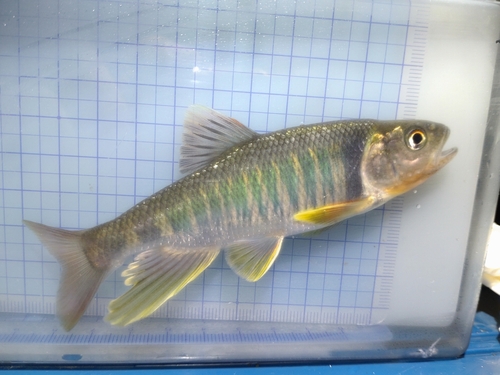
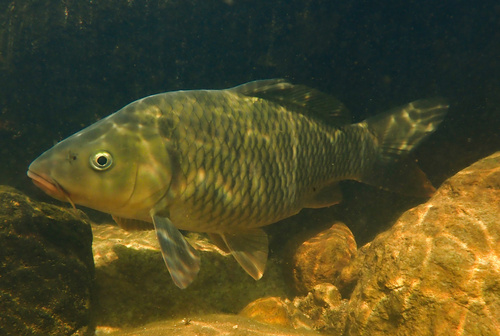
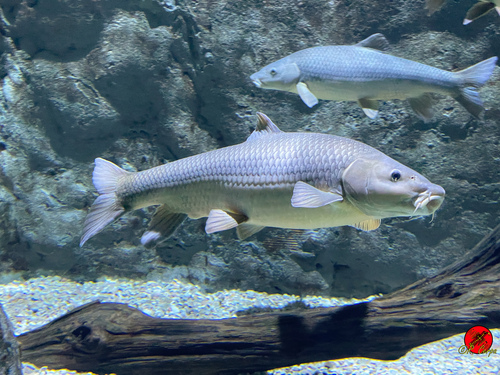
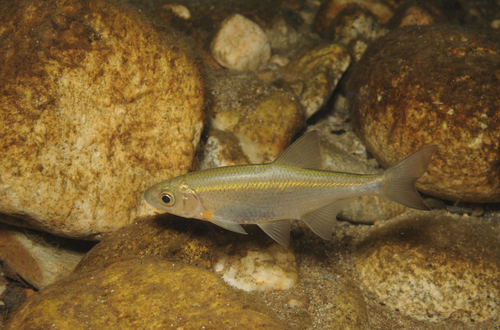
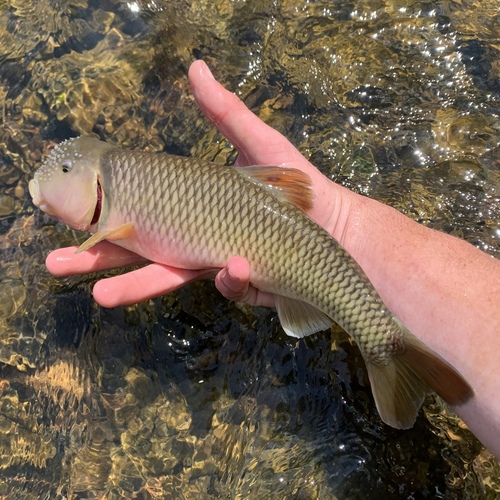
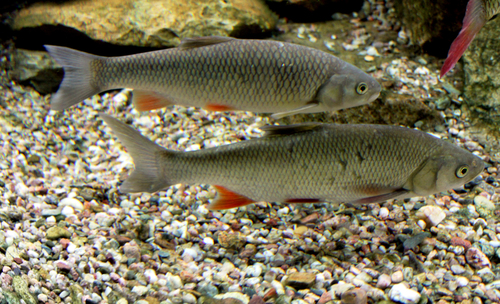
Squalius cephalus, commonly called chub, is a stocky fish with a large, rounded head. Its body is long and cylindrical, covered in large greenish-brown scales. These scales have narrow black edges across the back, the color pales to golden on the flanks, and is even paler on the belly. The tail is dark brown or black, the dorsal fin is greyish-green, and all other fins are orange-red. The dorsal fin has 3 spines and 7–9 soft rays, while the anal fin has 3 spines and 7–10 rays. This species has between 42 and 48 vertebrae. It can reach a standard length of 60 cm, though most individuals grow to around 30 cm. Its eggs are round with a diameter of 1.8 mm; newly hatched first-day larvae measure 6–7 mm long and weigh approximately 120 mg.
The chub is distributed across most of northern Eurasia. It occurs in rivers that drain into the North, Baltic, northern Black, White, Barents, and Caspian Sea basins, as well as Atlantic basins stretching south to the Adour drainage in France. In Great Britain it is found north to 56°, and in Scandinavia it occurs in southern Finland and southern Sweden, north to around the Stockholm area. Within the Mediterranean basin, it is present in France from the Var to the Hérault, and may also occur in the Aude and associated drainages. It is not a native species in Ireland or Italy, but has been introduced to both countries. In Italy, S. cephalus has been acclimatized for decades, but only occurs in scattered localities mostly within the Po river basin, and has never formed well-established populations.
Chub are most abundant in small rivers and large streams in the "barbel zone" that contains both riffles and pools. It can be found along the banks of slow-flowing lowland rivers, in large lakes, and even in mountain streams. Chub living in lakes perform spawning migrations into inflowing streams. Adult chub are solitary, while juvenile chub are social and form shoals. Larvae and juveniles prefer relatively shallow shoreline habitats, and these smaller fish eat a varied diet of aquatic and terrestrial animals. Large, solitary adults prey mainly on freshwater shrimp and small fish. In the United Kingdom, chub have been recorded feeding on worms, molluscs, crustaceans, and various insect larvae; large chub eat significant numbers of small fish including other chub, eels, common dace, common roach, gudgeon, and minnows, as well as frogs, crayfish, voles, and young water birds. They have also been observed eating berries such as blackberries and elderberry that fall from overhanging trees into the water. They feed throughout the year whenever opportunities are available, even on the coldest days of midwinter.
Spawning occurs when water temperatures reach 14 °C, and runs from May to September. Chub spawn in fast-flowing water over gravel substrates, and only rarely spawn among submerged vegetation. Females spawn more than once per season, and each female mates with several males. Males aggregate at spawning sites and follow gravid females, often with substantial splashing, into shallow riffles. Females lay pale yellow sticky eggs that adhere to gravel, weed, and stones in flowing water. Sexual maturity in chub is affected by environmental factors: males reach sexual maturity at 2–4 years old, while females reach it at 4–6 years old, though some individuals may mature much later. In the wild, chub can live up to 22 years. Age can be determined by counting the visible growth rings on scales, which correspond to seasonal growth patterns.