About Spyridium parvifolium (Hook.) F.Muell.
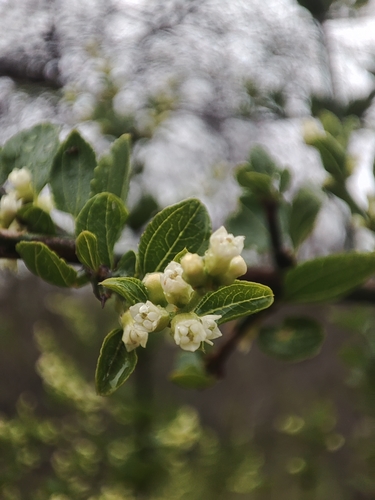
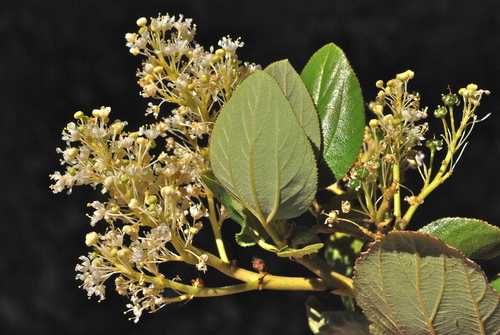
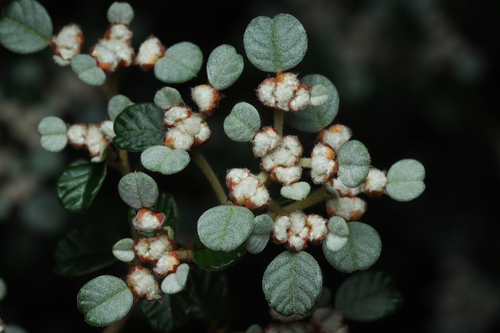
Spyridium parvifolium, commonly known as dusty miller, is a low, spreading shrub that reaches approximately 1.5 m (4 ft 11 in) in height. Its smaller branches are thickly covered in soft, long, rust-colored hairs. The dull green leaves are obovate, elliptic, or orb-shaped, measuring 4–18 mm (0.16–0.71 in) long and 3–13 mm (0.12–0.51 in) wide, with a rounded or notched apex. The upper leaf surface is usually veined, and ranges from densely covered in long, erect, rigid hairs to densely covered in short, soft, upright hairs. The lower leaf surface is thickly covered in whitish star-shaped hairs, sometimes with simple, rusty hairs over the veins; leaf margins are flat to curved under, and occasionally scalloped. Leaves positioned near the flowers have upper surfaces densely covered in white, short, matted hairs. The stipules are brown, 1–4 mm (0.039–0.157 in) long and 3–13 mm (0.12–0.51 in) wide, and covered in very fine hairs. The flowers are whitish and woolly, arranged in small heads that form leafy clusters in leaf axils at the end of branches. Flower clusters are about 3 cm (1.2 in) wide, and surrounded by cream-white floral leaves. Flowering occurs mainly in spring, and the fruit produced is approximately 3 mm (0.12 in) long. In terms of distribution and habitat, dusty miller grows on tablelands and slopes in New South Wales south of Burrinjuck Dam, and on the coast south of Twofold Bay. It also grows in Victoria, Tasmania, and South Australia. In cultivation, Spyridium parvifolium has a degree of frost and drought tolerance, and adapts well to most soils and positions that have adequate drainage. A prostrate cultivar named 'Austraflora Nimbus' spreads to 1 metre across, and is suited to growing in coastal gardens, rockeries, and containers.