About Sporobolus cryptandrus (Torr.) A.Gray
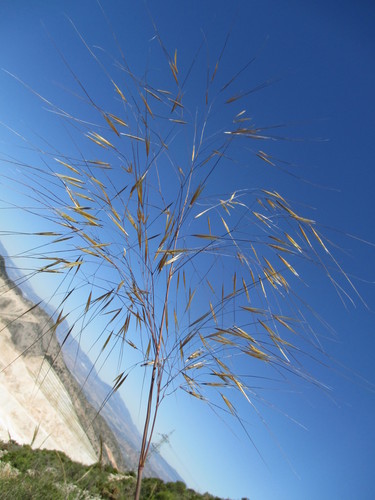
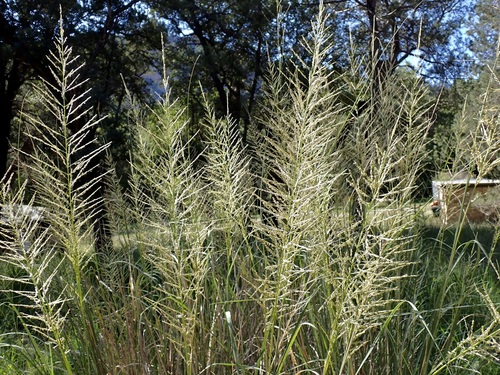
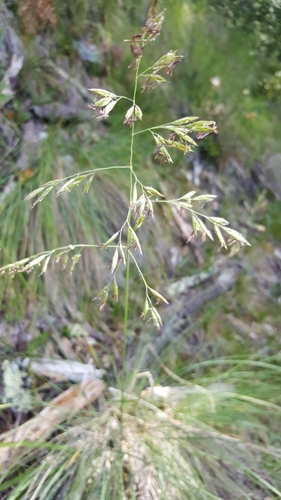
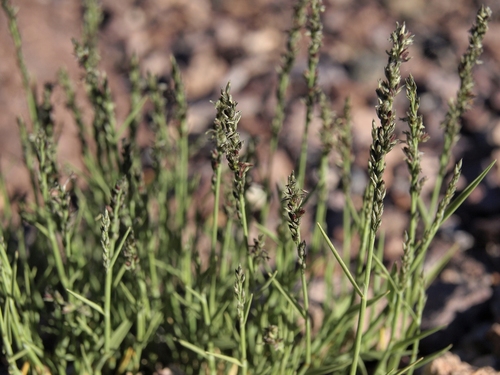
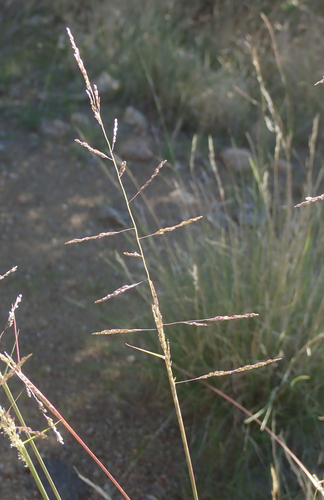
Sporobolus cryptandrus, commonly called sand dropseed, is a perennial bunchgrass that forms loose tufts of stems that grow erect to decumbent, reaching up to one meter in length. Stem bases are thickened but remain non-woody. Leaf margins have rough hairs; leaves can grow up to 26 centimeters (10 inches) long, and some grow perpendicular to their stems. The species' inflorescence starts out dense and narrow, spreads as it ages, and may remain partially sheathed within the uppermost leaf. Each inflorescence can produce up to 10,000 small seeds, a large number that improves the grass's ability to colonize new areas and maintain a persistent presence in the soil seed bank. These tiny seeds are approximately 1 millimeter in size, and are often sticky when wet, a trait that may help them disperse by attaching to animals or human equipment. Sand dropseed is a common grass across many types of North American prairies, and grows in a wide range of other habitats including disturbed areas like roadsides. Within its native North American range, it is common across a variety of habitats including prairies, sagebrush deserts, chaparral, and disturbed environments such as roadsides and dry riverbeds. It typically prefers sandy soils, and often acts as an early successional species in both arid and semi-arid ecosystems. It is considered a component of climax plant communities on deep sands, particularly at low elevations. Outside of North America, Sporobolus cryptandrus has become increasingly invasive in parts of Central and Eastern Europe. In Hungary, it has expanded rapidly since it was first discovered there in 2016, and has now been documented in over 620 localities. These localities include urban grasslands, degraded steppes, sandy forest-steppe mosaics, and old fields of various successional stages. It is especially common in disturbed and dry habitats, where it establishes along dirt roads, motocross trails, firebreaks, and plowed plantation edges. Its spread has been particularly pronounced in Hungary's Kiskunság and Nyírség regions, where large stands have formed in both natural and human-altered environments. The seeds of Sporobolus cryptandrus are eaten by a range of small birds and mammals, including scaled quail (Callipepla squamata) and black-tailed prairie dogs (Cynomys ludovicianus), so it acts as a food source in the ecosystems it inhabits. Ecologically, the species is notable for using the C4 photosynthetic pathway, which lets it photosynthesize efficiently under conditions of high light, high temperature, and drought. This physiology gives it a competitive advantage in the warm, dry environments where it thrives. One of the key defining ecological traits of Sporobolus cryptandrus is its ability to build a dense, long-lasting soil seed bank. Recent studies of invaded sites in Central Europe have recorded seed densities as high as 95,000 seeds per square meter in upper soil layers. Seeds are especially concentrated within the top 2.5 centimeters of soil, though viable seeds are often found deeper in the soil profile. The persistence of these seed banks lets the species rapidly recolonize areas after disturbances such as fire, mowing, or drought, and makes managing its invasive populations particularly challenging. Viable seeds have even been found in areas where the species is no longer visible growing above ground, showing that it has significant potential to re-emerge in the future. Seed bank studies have found that while increasing Sporobolus cryptandrus cover correlates with a higher proportion of its seeds in the soil, it does not necessarily cause a reduction in the density or diversity of seeds from other plant species. However, in aboveground vegetation, increasing cover of this grass is often linked to lower native species richness and altered plant community composition. This difference between soil seed bank and aboveground ecological patterns indicates there is a lag in the species' ecological impact, with belowground seed communities acting as a form of successional memory that can buffer or delay the effects of invasion.