About Sporobolus alterniflorus (Loisel.) P.M.Peterson & Saarela
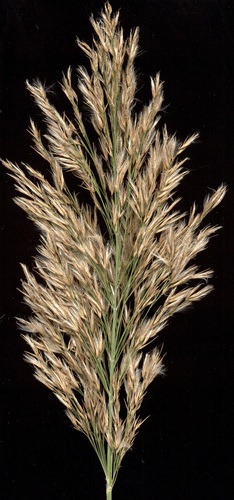
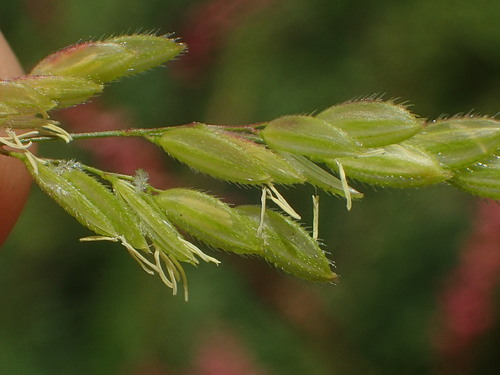
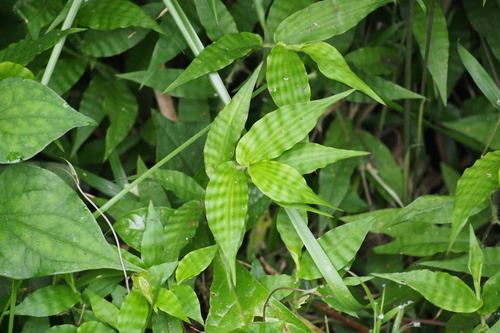
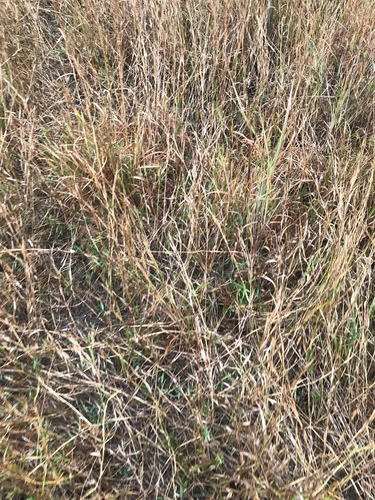
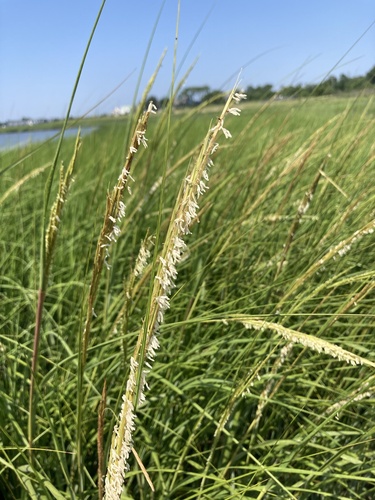
Sporobolus alterniflorus, also known by the synonym Spartina alterniflora, and common names smooth cordgrass, saltmarsh cordgrass, or salt-water cordgrass, is a perennial deciduous grass that grows in intertidal wetlands, particularly estuarine salt marshes. A 2014 taxonomic revision reclassified this species as Sporobolus alterniflorus, though the name Spartina alterniflora is still commonly used. In 2019, an interdisciplinary team of experts coauthored a report published in the journal Ecology that supports retaining Spartina as a separate genus. This species grows between 1 and 1.5 meters (3 feet 3 inches to 4 feet 11 inches) tall. It has smooth, hollow stems that bear leaves ranging from 20 to 60 centimeters (7.9 inches to 1 foot 11.6 inches) long, up to 1.5 centimeters (1/2 inch) wide at the base; leaves are sharply tapered and bend downward at their tips. Like its relative saltmeadow cordgrass S. patens, it produces flowers and seeds only on one side of the stalk. Its flowers are yellowish-green, and turn brown by winter. It spreads via rhizomes; broken rhizome fragments can grow into new individuals through vegetative asexual reproduction, and the rhizomes themselves are an important food source for snow geese. Sporobolus alterniflorus can grow in both low marsh, which is frequently inundated by tides, and high marsh, which is less frequently inundated, but it is usually restricted to low marsh because it is outcompeted by salt meadow cordgrass in the high marsh. It tolerates a wide range of salinities, from approximately 5 psu to full marine salinity of 32 psu, and it is called the "single most important marsh plant species in the estuary" of Chesapeake Bay. This species is intolerant of shade. Sporobolus alterniflorus acts as an environmental engineer: it grows outward into water along the seaward edge of a salt marsh, accumulates sediment, and allows other habitat-engineering species such as mussels to settle. As sediment and substrate-building species accumulate, the land level gradually builds up along the seaward edge, and higher-marsh species then colonize this new land. As the marsh accretes sediment, S. alterniflorus continues moving further outward to form a new marsh edge. Within a Sporobolus belt, the tallest individuals grow at the outermost edge of the marsh, with shorter growth forms occurring moving landward. S. alterniflorus is native to the Atlantic coast of the Americas, ranging from Newfoundland, Canada, south to northern Argentina, where it makes up a dominant component of brackish coastal saltmarshes. To date, the caterpillars of Aaron's skipper (Poanes aaroni) have only been found on this species.