About Sporobolus africanus (Poir.) Robyns & Tournay
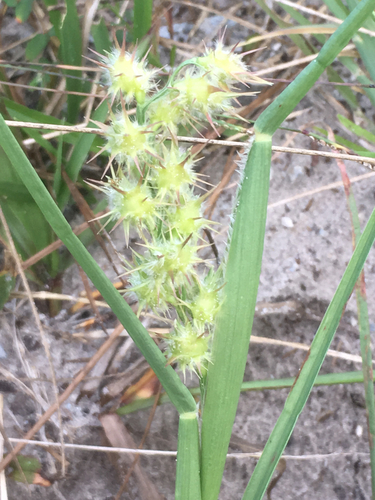
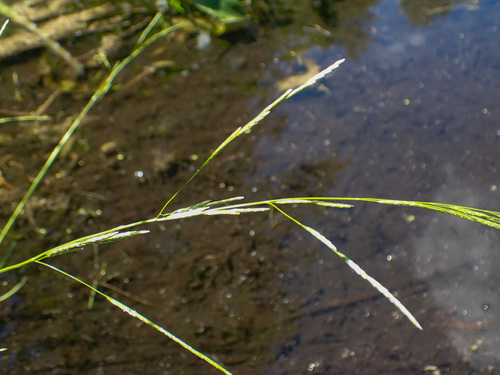
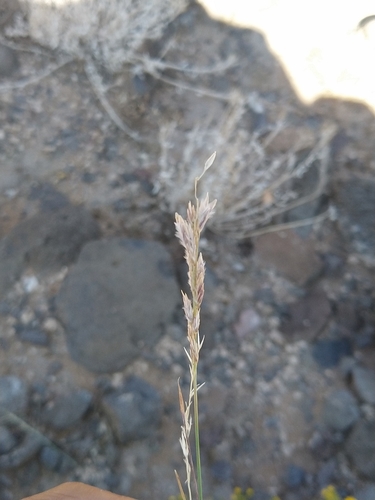
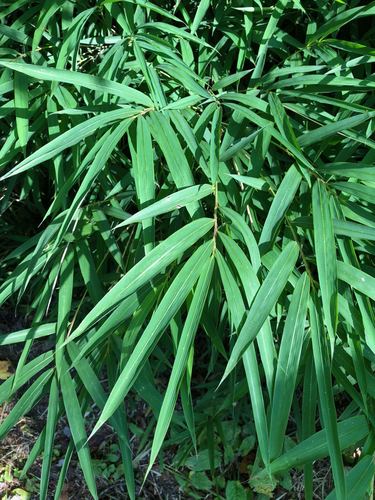
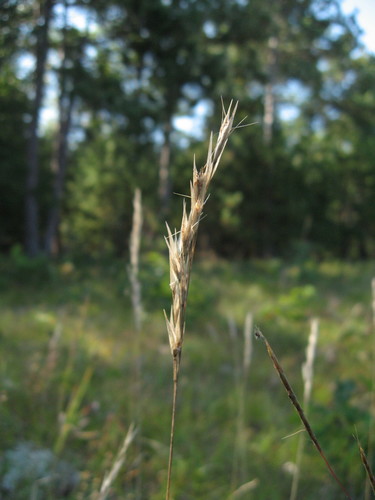
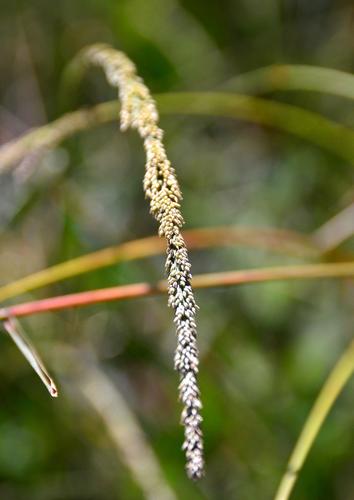
Sporobolus africanus is an erect, stiff, tufted perennial grass. Its leaves measure 20–40 cm long and 1–4 mm wide, are in-rolled, scabrid, and olive-green. The panicle is 9–22 cm long, forming a long, densely packed grey-brown inflorescence that bears 2.2–3 mm spikelets, each containing a single floret. The native range of this species spans southern and eastern Africa, from the Democratic Republic of the Congo to South Africa, and additionally includes Kenya, Eswatini, Ethiopia, Nigeria, Cameroon, Arabia, and Sri Lanka. Within South Africa, it is found in Free State, Gauteng, KwaZulu-Natal, Limpopo, Mpumalanga, Northwest, and the Northern, Western, and Eastern Cape Provinces. Sporobolus africanus is naturalized in Madagascar, the Philippines, and Australasia, which includes Papua New Guinea, New Zealand, Australia, and Lord Howe Island, Norfolk Island, and Kermadec Island. It is also naturalized across the Pacific (Cook Islands, Easter Island, Hawaii, Niue, Tokelau-Manihiki, French Polynesia, Mariana Islands), Atlantic Ocean islands (the Azores, Canary Islands, Madeira, Ascension, Tristan da Cunha, and St. Helena), and Indian Ocean islands (Mauritius and Réunion). Sporobolus africanus typically grows in compacted soils and adapts well to low-fertility conditions. It grows in open areas, including lawns, pastures, footpaths, parks, roadsides, disturbed sites, native grasslands, and open woodlands. In cool-temperate South African grasslands, Sporobolus africanus is often found in association with the grasses Eragrostis curvula, Cynodon dactylon, and Hyparrhenia hirta, as well as herbs including Walafrida densiflora, Solanum species, and Wahlenbergia caledonica. Sporobolus africanus is a prolific seed producer, with an average of 300 seeds per inflorescence and up to 3,600 seeds per square metre. Its seeds become sticky when wet, allowing them to attach directly to animals, clothing, and machinery. This species also tends to build up long-lasting seedbanks, which can further enable its spread when mud containing seeds is moved by machinery.