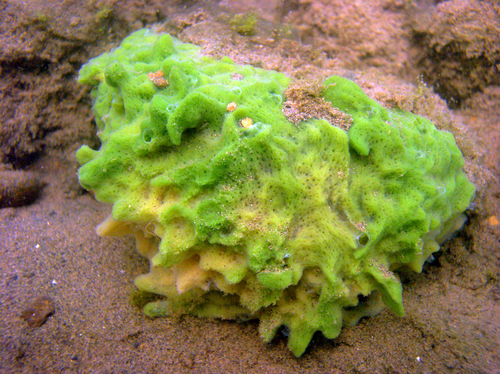
About Spongilla lacustris (Linnaeus, 1759)
Spongilla lacustris can grow in several growth forms: branching, clump-like, and crust-shaped. On average, this sponge reaches a few inches in length. Its color ranges from white to green, which depends on the amount of zoochlorella, a type of green algae tissue, present in the sponge. This alga has a symbiotic relationship with the freshwater sponge: the algae help the sponge take up oxygen and food, while the sponge provides a living surface for the algae. The sponge itself has a soft texture. Small dermal pores called ostia allow water to enter the sponge for filtering, and a larger opening called the oscula allows water to exit. Though the oscula is larger than the ostia, both openings are extremely small and hard to see. Silica spicules cover the sponge's thin dermal membrane, and while they provide structural support and protection to the sponge, they do not change the soft overall texture of the organism. Freshwater sponge spicules occur in many sizes and forms, including microscleres, emmula microscleres, and parenchyma macroscleres. Spongilla lacustris, a freshwater sponge, reproduces both sexually and asexually, with two distinct methods of asexual reproduction: gemmule formation and budding. Gemmules are complex, highly resistant resting stages formed by the sponge. While gemmules can form at any point during the growing season, most formation happens in autumn, triggered by seasonal changes in light and temperature. They develop when food-filled archaeocytes (also called amoebocytes) migrate together to form discrete masses. This archaeocyte core becomes wrapped in multiple layers of hardened membrane that form a protective shell. Gemmules can survive repeated freezing and thawing, desiccation, and extended periods of darkness. When environmental conditions improve and water temperature rises above 13 to 23 °C, germination occurs: the young sponge leaves its shell and begins growing as a new individual. The second asexual reproductive method is budding, which takes place in spring. During budding, the sponge forms buds in its outer layer; these buds eventually drift away from the original sponge to grow into new colonies. Sexual reproduction occurs in summer. Spongilla lacustris is hermaphroditic, meaning each individual sponge produces both sperm and eggs. Sperm are released into the water, and travel into the ostia of another sponge to fertilize eggs. After development inside the sponge's inner cavity, the sponge gives birth to live, free-swimming larvae. Spongilla lacustris is a filter feeder that eats small floating organic particles. It is eaten by Sisyridae, a group of winged insects commonly called sponge flies or spongillaflies. Sisyridae larvae parasitize the sponge and feed exclusively on it during their larval stage. Insects of the genus Ceraclea also feed on Spongilla lacustris, and use the sponge's spicules to build hard, protective cases for themselves. As the Ceraclea larva grows, it adds not just spicules but also pieces of the sponge itself to its casing. When the adult Ceraclea matures and leaves the sponge, it carries and disperses these sponge fragments, which helps new Spongilla lacustris colonies form.

