About Spondyliosoma cantharus (Linnaeus, 1758)
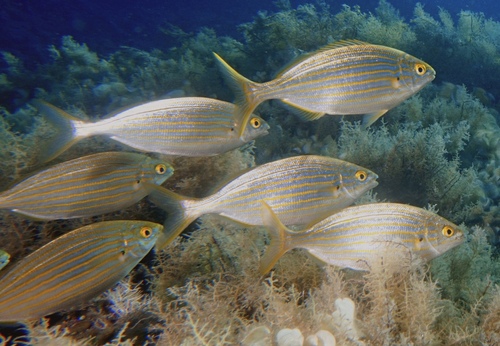
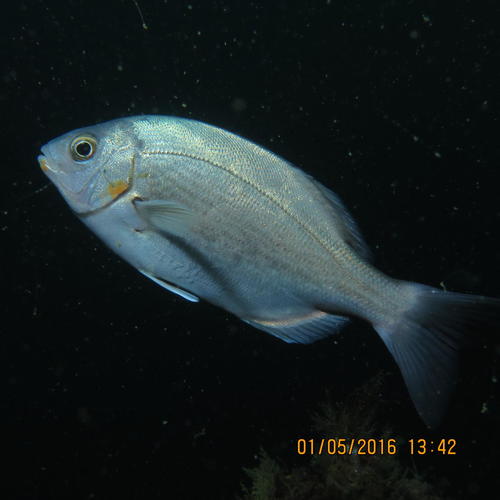
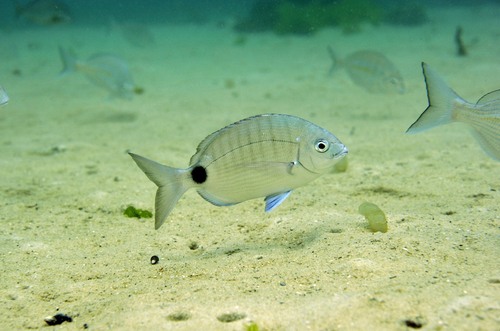
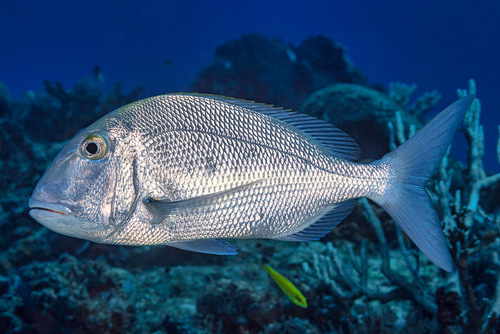
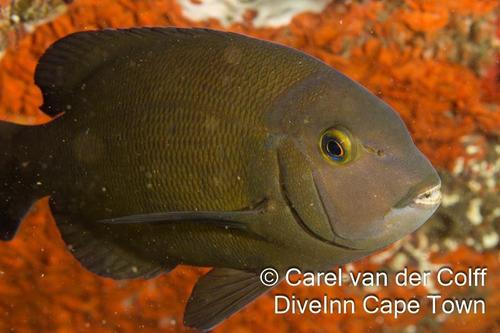
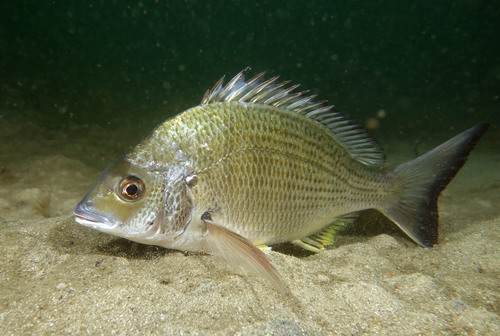
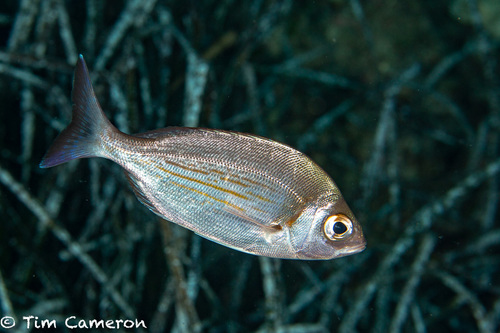
Black seabream, Spondyliosoma cantharus, has a moderately deep body with a small, round-profiled head. Its mouth reaches back as far as the front of the eye, and adult black seabream have a convex dorsal head profile. The dorsal fin is supported by 11 spines and 11 to 13 soft rays, while the anal fin is supported by 3 spines and 9 to 11 soft rays. No scales grow on the cheeks, operculum, or preoperculum. Both jaws hold 4 to 6 rows of thin, conical teeth; the outer teeth are enlarged, particularly at the front of the jaw. The caudal fin is slightly forked. The upper body of this fish is dark grey, and its flanks are silvery, with 6 to 9 dark vertical bars running along the body. Males may turn almost completely black when nesting. The maximum published total length for this species is 60 cm (24 in), though 30 cm (12 in) is a more typical length, and its maximum published weight is 1.2 kg (2.6 lb).
Black seabream has a wide distribution in the eastern Atlantic Ocean, ranging from Scandinavia in the north to Namibia in the south. Its range also includes Macaronesia, the Mediterranean, and the western Black Sea. It occurs at depths between 5 and 300 m (16 and 984 ft), and lives over seagrass beds, rocky substrates, and sandy substrates.