About Spondias mombin Jacq.
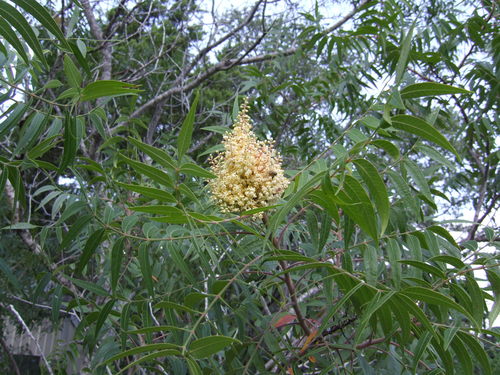
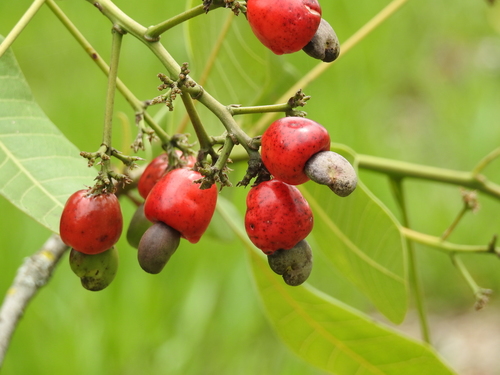
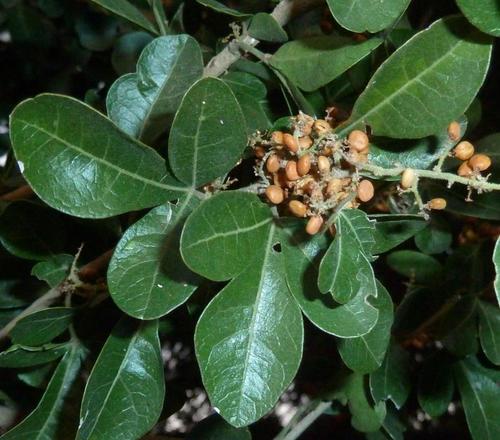
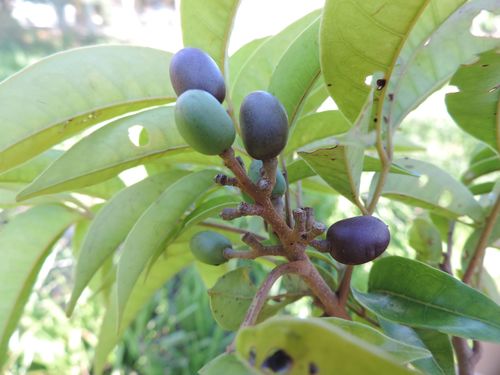
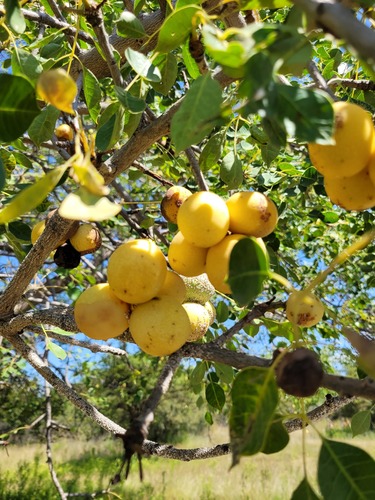
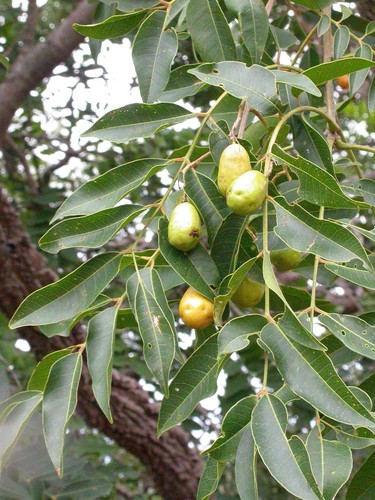
Spondias mombin Jacq., commonly known as hog plum, is a small deciduous tree that reaches up to 20 m (66 ft) in height and 1.5 m (4.9 ft) in girth, with moderate buttressing. Its bark is thick, corky, and deeply fissured; when cut, the inner bark is pale pink and darkens quickly. It grows low branches, and its branchlets are glabrous. The leaves are pinnate, with 5 to 8 pairs of opposite leaflets plus a single terminal leaflet. Each leaflet measures 10 cm × 5 cm (4 in × 2 in), with an oblong or oblong lanceolate shape, a broadly acuminate tip, and a glabrous surface. Sweet-scented flowers bloom from January to May; they are small, white, and arranged in large, loose terminal panicles. Fruits develop from July to September. They are roughly 4 cm (1.5 in) long, ovoid, and yellow when ripe, with a sharp, acidic flavor. They become wrinkled when dry, are edible, and their soft flesh surrounds a single spiny kernel. As food, the fruit pulp can be eaten fresh, or processed into juice, concentrate, jellies, and sherbets. In Nepal, this fruit is called Lapsi (लप्सी), and also known as amaaro in some local regions. Its pulp is most commonly used to make a pickle called Lapsi ko achaar (लप्सीको अचार), and also made into a dried product called Lapsi Ko Maada (लप्सीको माड़ा). In Thailand, this fruit is called makok (Thai: มะกอก), and it is used as a secondary ingredient in the dish som tam. The plant’s young leaves have a slightly bitter and sour taste, and are sometimes served raw alongside certain types of nam phrik (Thai chili pastes). In Bangladesh, where the fruit is called আমড়া (amṛa), it is also served with chili powder. In India, it is known as Amado in Konkani, അമ്പഴം (ambazham) in Malayalam, and omora in Assamese. This species belongs to the sumac family (Anacardiaceae). Exposure to its sap can cause the same allergic reaction that contact with poison ivy produces, so people who are known to be sensitive to urushiol should take caution when handling or consuming this plant. In traditional medicine, Spondias mombin has a wide range of recorded uses. The fruit has been used as a diuretic and a febrifuge. The bark is astringent, and has been used as an emetic, as well as to treat diarrhea, dysentery, hemorrhoids, gonorrhoea, and leukorrhea. Flowers and leaves are brewed into a tea used to treat stomach ache, biliousness, urethritis, cystitis, and inflammation.