About Spodoptera exigua (Hübner, 1808)
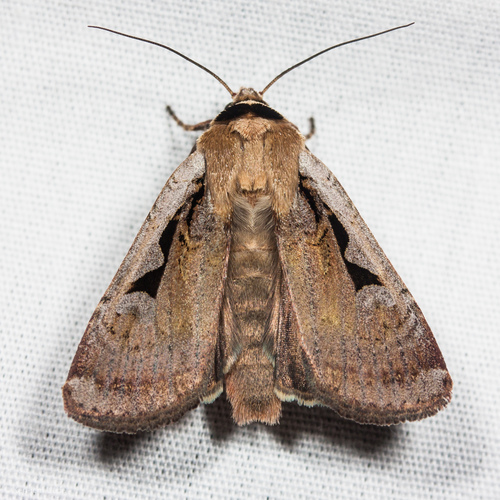
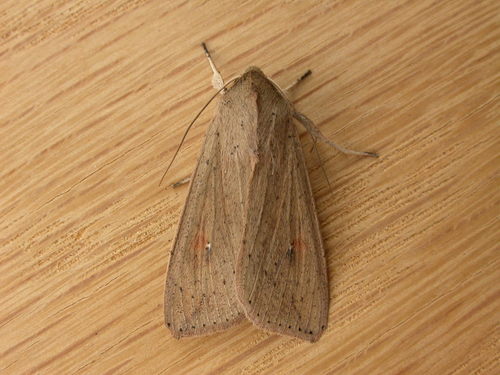
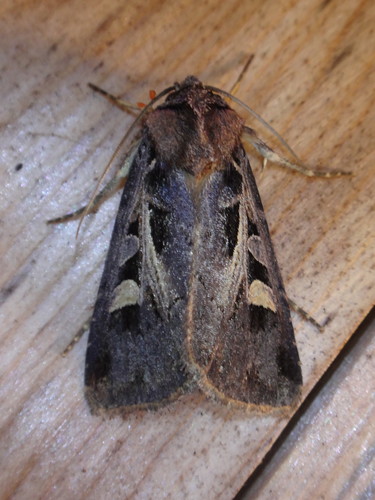
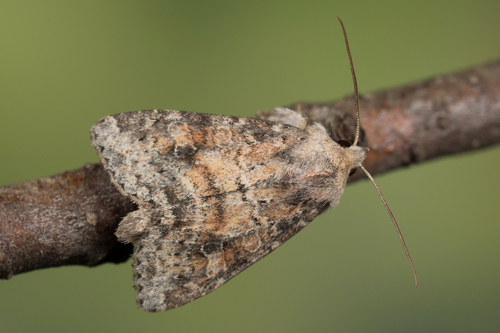
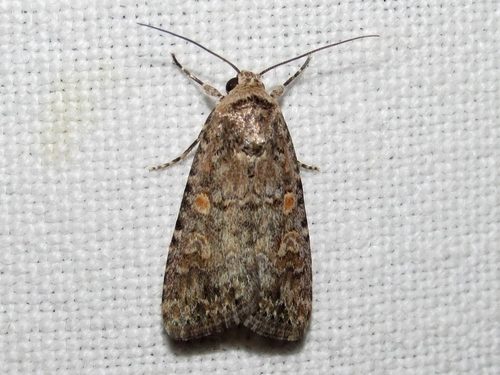
Adults of Spodoptera exigua are drab brown or grey moths with a wingspan ranging from 26 to 32 millimetres (1 to 1+1⁄4 inches). The forewings are greyish ochreous, overlaid with dull yellow and dusted with black scales. The inner and outer lines of the forewing are double, indistinct, and filled with a pale yellowish colour. A dark wavy median shade is visible in front of the lower half of the outer line, and the cell of the forewing is dark brown. The round orbicular stigma is pale or bright yellow, while the reniform stigma has a curved brown lunule in its centre. The submarginal line is pale grey, and a darker shade lies before this line, with dark streaks running between the veins. The terminal spots on the forewing are black. Hindwings are semihyaline white with dark brown veins, and all three margins are shaded with fuscous colour. Larvae are pinkish brown, marked with irregular black blotches. The spiracular line is pale ochreous with a dark upper edge. These larvae are greenish-brown cutworms, soft, bulging caterpillars that have dark longitudinal stripes. Ecologically, this species, commonly called the beet armyworm, has a very wide host range. Known host plants include asparagus, beans and peas, sugar beets and table beets, celery, cole crops, lettuce, potato, tomato, cotton, cereals, oilseeds, tobacco, cannabis, many types of flowers, and a large number of weed species. The beet armyworm cannot tolerate cold temperatures. It is able to overwinter in warm regions such as Florida and Hawaii. In colder areas, the entire population dies off over the winter, and the region is only reinvaded by adult moths once weather warms up and crop plants begin to sprout.