About Spizaetus isidori (Des Murs, 1845)
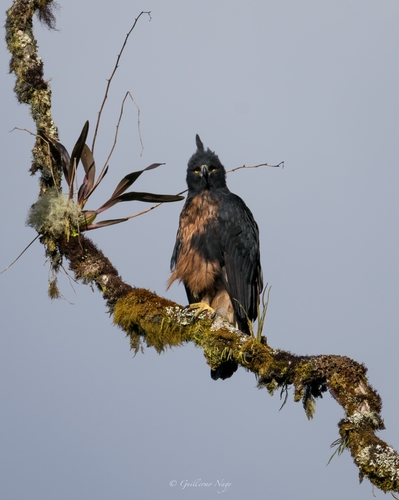
Spizaetus isidori, commonly called the black-and-chestnut eagle, is a fairly large eagle and very large raptor, with a total length of 60 to 80 cm (24 to 31 in) and a wingspan of 147 to 180 cm (4 ft 10 in to 5 ft 11 in). It is the largest living member of the genus Spizaetus; even the smallest males of this species are somewhat larger in linear measurements than the largest female ornate hawk-eagles. Reported body weights for fully grown black-and-chestnut eagles range from 1.5 to 3.5 kg (3.3 to 7.7 lb). It falls among Neotropical eagles around the same body size as the two largest Buteogallus and the black-chested buzzard-eagle, is at least twice as heavy as other Spizaetus species, and is slightly heavier than the notably longer crested eagle. Among all Neotropical eagles, only the harpy eagle is considerably larger. Most other eagles are absent from the high elevation forest habitat of the black-and-chestnut eagle, with the exception of the solitary eagle. Compared to other members of its genus and most other genera of forest-dwelling raptors, it has a proportionately short tail and proportionately long wings, but it is still longer-tailed and shorter-winged than most open-country true eagles. Like most raptors, females are notably larger than males, by approximately 4% to 14%, and also have longer tails. In males, wing chord measures 463 to 488 mm (18.2 to 19.2 in) and tail length measures 283 to 300 mm (11.1 to 11.8 in); in females, these measurements are 508 to 528 mm (20.0 to 20.8 in) for wing chord and 329 to 335 mm (13.0 to 13.2 in) for tail length. A small sample of individuals measured 110 to 120 mm (4.3 to 4.7 in) in tarsus length. The talons of this species are very large and formidable for an eagle of this size. The average length of the enlarged hallux claw, the species' main killing apparatus, is 50.9 mm (2.00 in) for 6 sampled females and 46.4 mm (1.83 in) for 6 sampled males. These claw sizes are nearly as large as those of the much bigger golden eagle. As an adult, this species has glossy black plumage on its head and back, and rich, somewhat streaky chestnut plumage on its underside, most of the wing secondaries, and even its legs. Black-tipped white feathers on the wing primaries contrast strongly with the chestnut secondaries and underwing coverts. The adult's tail is grayish with a thick black subterminal band. Adult black-and-chestnut eagles have orange-yellow eyes and yellow bare parts, apart from a somewhat proportionately small gray bill. Juvenile birds are very different from adults, with whitish plumage on the head and body, a buffy wash on the underside, and scaly grey-brown plumage on the back and mantle; this dark scaly area is more extensive than in other whitish juvenile Spizaetus. Where adults have chestnut coloration on the wings, juveniles have whitish coloration, and the juvenile's remaining wing feathers have a much more varied black-and-white pattern. The juvenile's tail has two distinct black bands. Juveniles have blue-gray eyes, which later turn yellow before becoming orange as the bird reaches maturity. Maturation occurs gradually over four years; this timeline is about average for a large eagle, but is nearly twice as long as it is for some other Spizaetus species. Adult black-and-chestnut eagles are practically unmistakable. If only the dorsal side is visible, they can still be distinguished from the black hawk-eagle by their larger, much bulkier frame and distinctive tail pattern on a conspicuously relatively shorter tail. Juvenile black-and-chestnut eagles are more similar to juveniles of the other two Spizaetus species, but they are distinctly larger, bulkier, and proportionately shorter-tailed than both, and each of the other species has a slightly different distinctive juvenile plumage pattern on the wing primaries and tail. The black-and-white hawk-eagle is far smaller, and unlike the ornate hawk-eagle, it is not known to occasionally reside in cloud forests. Juvenile pale morph crested eagles can appear surprisingly similar to juvenile black-and-chestnut eagles in flight, but they are conspicuously longer-tailed and have a stronger barring pattern. Furthermore, there is little to no range overlap between the black-and-chestnut eagle and other Spizaetus species or crested eagles, due to the black-and-chestnut eagle's distinct habitat preferences. The solitary eagle is unlikely to be confused with the black-and-chestnut eagle; it has much broader wings, lacks all chestnut pigment, and has an almost inverse tail pattern to adult black-and-chestnuts on a rather shorter tail. Unlike other crested raptors, the black-and-chestnut eagle reportedly holds its crest upright during calm periods and in flight, and is more likely to hold its crest flat when under stress. The black-and-chestnut eagle is found in humid montane forests, normally at elevations between 1,800 to 2,500 m (5,900 to 8,200 ft), in the Andes from northern Argentina, through Bolivia, Peru, Ecuador, and Colombia, to Venezuela. It also has isolated populations in the Venezuelan Coastal Range, Serranía del Perijá, and Sierra Nevada de Santa Marta. It is generally localized and rare. Widespread clearing of primary forest in foothills across the Andes is the primary cause of the species' steep population decline. Deforestation is rampant in the Andes' forests, as it is across much of the tropics. It is estimated that there may be only 370–1500 black-and-chestnut eagles left in the wild, of which 250–999 are mature individuals, a lower total than previously estimated. It is one of the most endangered birds of prey in the Americas. Its conservation status is made worse by continued persecution, as people kill it for killing domestic fowl. Black-and-chestnut eagles are a control species because they help maintain ecosystem balance by hunting other animals for food. Nest building occurs in February and March, eggs are laid in April and May, and young fledge by August and September. The species builds a huge stick nest approximately 2 m (6.6 ft) across and 1 m (3.3 ft) deep. Clutches produce 1 to 2 fledglings. In some areas, adult eagles primarily bring squirrels to feed their young at the nest. In a nest observed in Argentina, the female visited the nest more often and invested more time in nest building than the male. In this Argentine nest, the female was responsible for incubation and incubated every night, while the male provided prey for both adult birds and briefly incubated when the female left the nest. After hatching, the female does all brooding, feeding, and defense of the chick, while the male continues to provide prey. This division of roles reflects typical parental behavior for raptors and eagles, but the division appears somewhat more rigid in this species, as the male has never been observed taking on brooding responsibilities. Black-and-chestnut eagles hunt primarily in the forest canopy. They soar frequently and tend to be rarely seen when perched. This species has powerful legs and talons adapted for catching large prey. Individuals frequently have heavily abraded tails from plunging after prey through tree branches. The main prey is usually small-to-medium-sized arboreal mammals, including red-tailed squirrels (Sciurus granatensis), opossums (Didelphis sp.), and stump-tailed porcupines (Coendou rufescens). Occasionally, the species takes carnivorans such as kinkajous (Potos flavus), coatis (Nasuella olivacea & Nasua nasua), and monkeys such as gray-bellied night monkeys (Aotus lemurinus), tufted capuchins (Sapajus apella), and even woolly monkeys (Lagothrix lagothricha). Birds are an important prey source in some regions, mainly guans such as Andean guans (Penelope montagnii) and sickle-winged guans (Chamaepetes goudotii), though smaller birds such as band-tailed pigeons (Patagioenas fasciata) are also taken. Black-and-chestnut eagles sometimes hunt chickens, including full-sized adult chickens, which has contributed to persecution of this endangered species. However, one small dietary study conducted in Colombia found that chickens made up 14.7% of the species' diet, while wild Andean guans were taken much more frequently, making up 53.9% of the diet. In this study area, black-and-chestnut eagles took roughly the same number of western mountain coatis as they did chickens, and coatis are known predators of poultry chicks and eggs. The black-and-chestnut eagle's range overlaps with that of several other large forest eagles, including other Spizaetus eagles, but few interactions have been reported. Because black-and-chestnut eagles often occur at slightly different altitudes than other Neotropical forest eagles, it is believed to normally be the top avian predator within its range. An exception is the similarly sized solitary eagle; preliminary reports indicate that solitary eagles mostly hunt snakes, while black-and-chestnut eagles prefer birds and small-to-medium-sized mammals. The two species were observed flying near each other without aggression in southeastern Peru, suggesting prey partitioning allows them to coexist. In the same area, black-and-chestnut eagles were observed aggressively displacing turkey vultures, possibly because turkey vultures sometimes steal eggs from bird nests.