About Spisula solidissima (Dillwyn, 1817)
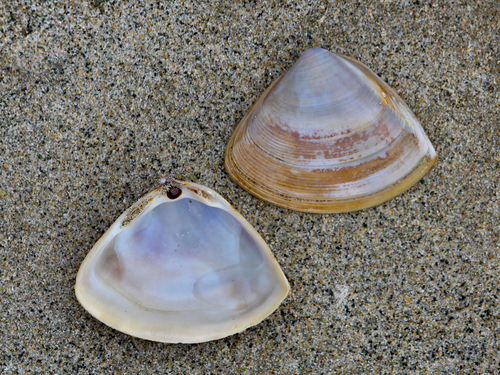
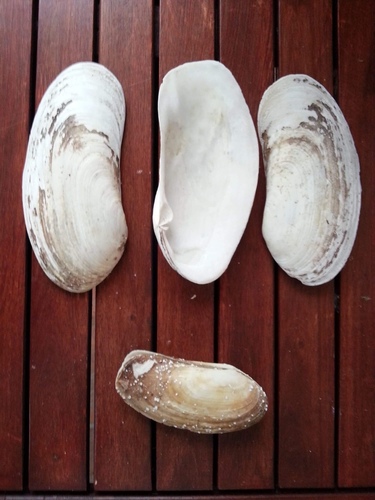
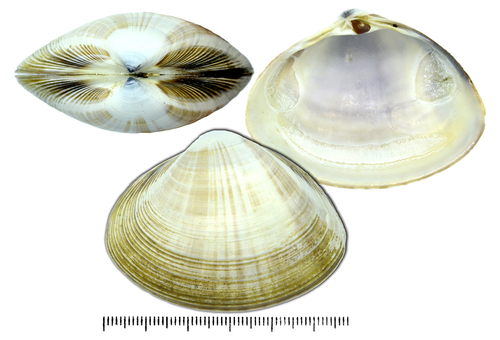
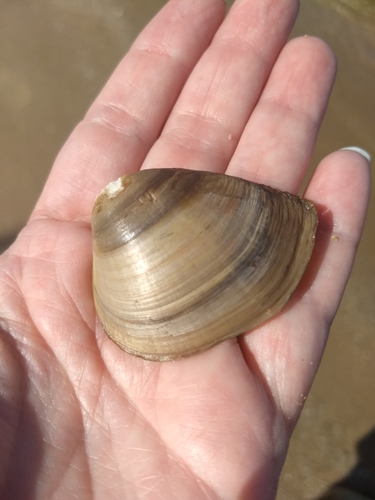
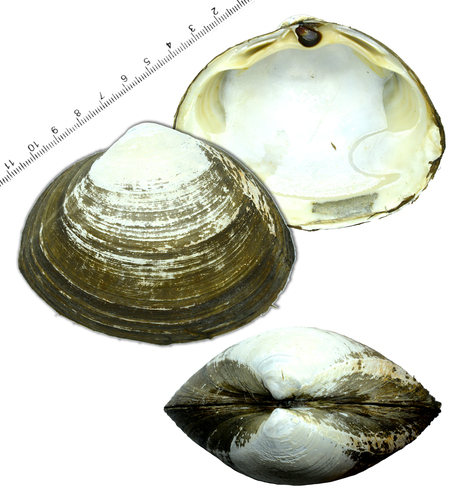
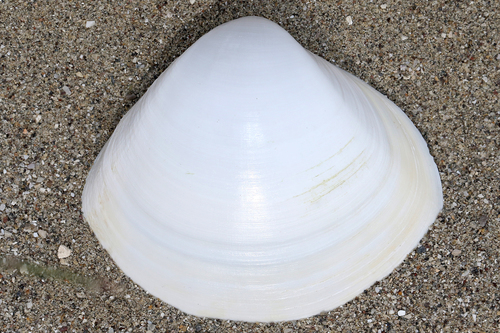
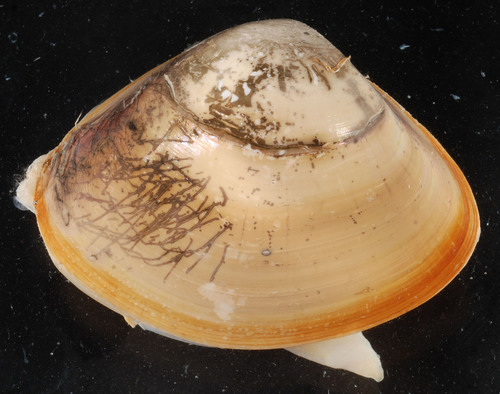
The Atlantic surf clam, with the scientific name Spisula solidissima (Dillwyn, 1817), is also commonly known as the bar clam, hen clam, skimmer, or simply sea clam. It is a very large, edible, saltwater marine bivalve mollusk that belongs to the family Mactridae. It is one of the most commonly found bivalve species in the western Atlantic Ocean. This species can reach a length between 7.9 and 8.9 inches (20 and 23 cm), which makes it much larger than Spisula solida, a related species that lives in the eastern Atlantic coastal waters. The empty shells of Atlantic surf clams are well known to beachgoers in the northeastern United States; people often collect these large empty shells to dig in sand, or take them home to use as decorative dishes or ashtrays. This species is exported commercially as a food product.
This common species is distributed along the east coast of North America, ranging from New Brunswick to South Carolina. Atlantic surf clams live buried in coarse or fine sand, and they can be found offshore, as well as in the low intertidal zone and surf zones.
Atlantic surf clams reproduce primarily in late summer, between August and October, when water temperatures reach their annual peak. Reproduction happens through external fertilization. Sex cells are released through the same water passage the clam uses for respiration and digestion. For both male and female Atlantic surf clams, there are five described stages of sexual organ development: early active phase, late active phase, ripe, partially spawned, and spent. The ripe phase is the main period when clams reproduce.
This species is commercially exploited, and has long been valued for its sweet flavor. It is typically harvested by fishing vessels called dredgers, which use a specialized fishing dredge fitted with high-power hydraulic jets. These jets fluidize the sea floor to loosen clams from sediment before the dredge scoops them up. Around two-thirds of a surf clam's shucked weight is suitable for human consumption. Its meat is used to make clam strips, chowder, and sushi. The clam's "tongue" or foot is commercially valuable, as it is cut into long strips that are breaded and fried to serve as clam strips, a preparation first popularized by the Howard Johnson's franchise. Remaining meat separated from the clam's "belly" is called "salvage" in the clam industry. This salvage meat includes the adductor muscles, the strong muscles that close and hold shut the two halves of the clam's shell. Salvage is typically ground up for use in chowders, sauces, and dips, and is sold commercially in canned or frozen form, and is available fresh locally. Some fishermen use the substantial clam belly as bait for striped bass and other fish species.