About Spissistilus festina Say
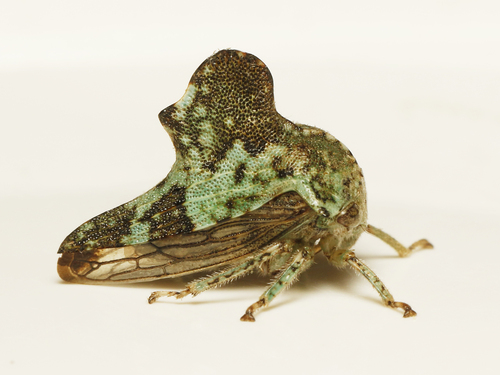
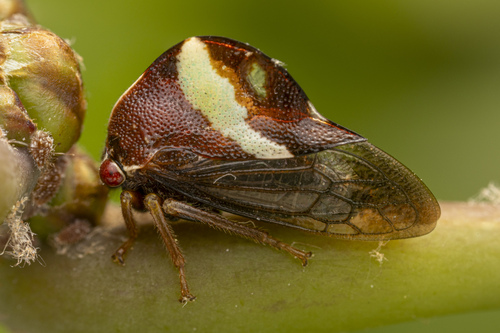
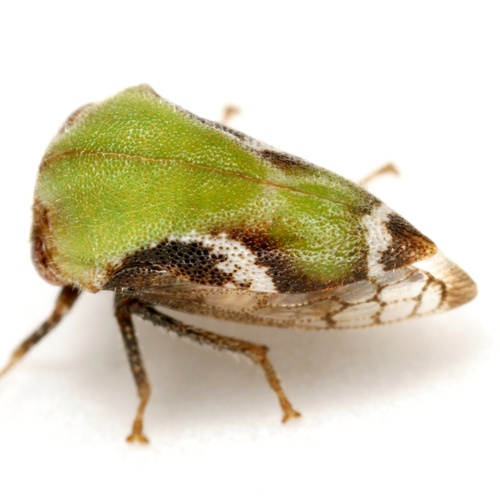
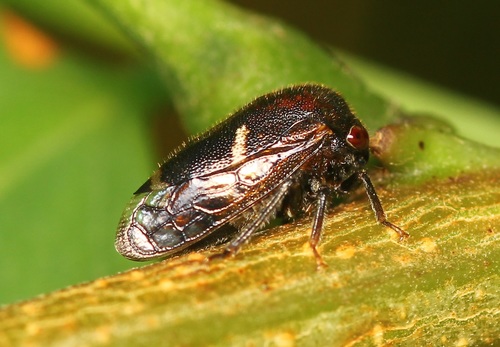
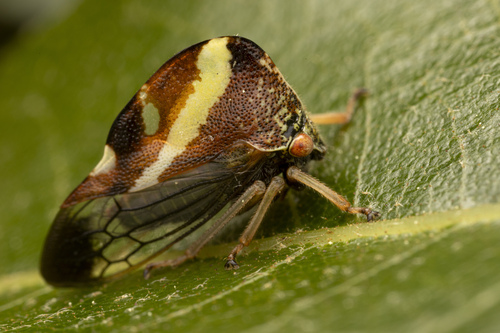
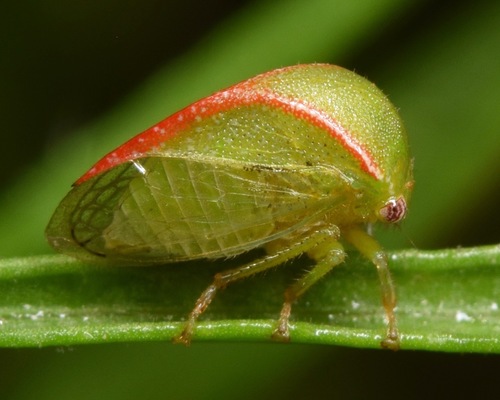
Adult Spissistilus festina Say measure 6–7 mm in length, and have a pronotum that extends all the way to the tip of the abdomen. The species’ common name comes from the shape of this pronotum: it has three corners, one at the apex and one at each shoulder, which creates a three-cornered appearance when viewed from the front. Live adult individuals are light green; dried, pinned specimens turn a deep orange to straw color. Adult males can be told apart from females by their distinctly smaller body size, plus a red tint on the dorsal side of the pronotum.
S. festina has a hemimetabolous life cycle with three stages: egg, nymph, and adult. Eggs produced by females are white, oblong, and measure 0.9 to 1.3 mm long. Each egg has one small end and one large end; the larger end is covered in papillae, which are thought to anchor the egg inside host plant tissue. Female S. festina use an ovipositor to cut a slit under the epidermis of a host plant, and oviposition behavior varies by host plant species. In alfalfa, eggs are usually laid near the base of the plant, just below the soil surface. The number of eggs laid per slit also depends on the host plant species.
After oviposition, embryonic development takes 6 to 27 days before a nymph hatches from the egg. Nymphal development usually lasts 18 to 33 days, though it may take longer when temperatures are far from 30 °C. There are typically 5 instars, but the number can range from 4 to 6; the total number of instars and the length of each instar depend on temperature and nutritional conditions. The first instar is 1.6 mm long, and the second is 2.1 mm long; both instars develop a series of spurs along the length of the spine. The third instar is 2.9 mm long, and shifts from a pale green or straw color to a darker yellow-brown with green markings. The first three instars each usually last 3 to 5 days. The fourth and fifth instars each last 4 to 8 days; these instars develop more distinct wing pads, spurs, and pronotum, and become progressively greener as they grow. Across the third to fifth instars, dorsal spurs grow more prominent, and mobility becomes significantly greater than that of the first and second instars.
Females mate soon after reaching sexual maturity, which occurs 7–14 days after they become adults. Males die quickly after mating, while females live for an additional 38.6 days on average. A female’s reproductive period lasts approximately 38 days, during which she can lay more than 220 eggs total, and carries 21–30 eggs in her ovaries at any one time.