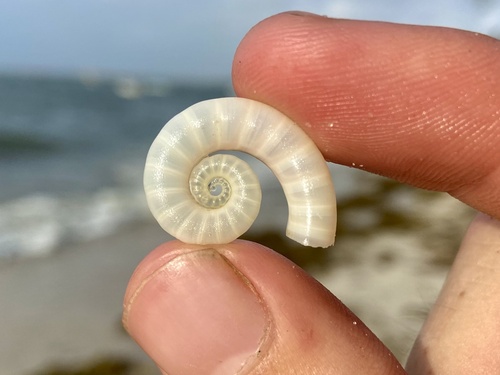
About Spirula spirula (Linnaeus, 1758)
Spirula spirula has a squid-like body that ranges from 35 mm to 45 mm in length. It is a decapod, with eight arms and two longer tentacles, all of which bear suckers. Both arms and tentacles can be completely withdrawn into the mantle. This species either lacks a radula entirely, or only has a vestigial radula at most. By day, Spirula spirula lives in deep oceans, reaching depths of up to 1,000 m. At night, it moves upward to depths between 100 m and 300 m. It prefers temperatures around 10 °C, and generally lives near oceanic islands and close to the continental shelf. Most sources categorize this as a tropical species, and it is abundant in the subtropical seas surrounding the Canary Islands. Empty shells of the species are regularly found along the western coasts of South Africa. In 2022, confirmed new records of the species were documented in the Arabian Sea. Significant numbers of shells from dead Spirula spirula are regularly washed ashore even in temperate regions, such as the coasts of New Zealand. These shells are highly buoyant, so they may have been carried long distances by ocean currents. Most details of this species' life history have never been directly observed. For example, it is thought to spawn in winter in deeper water, but no spawnlings have ever been directly seen. Individuals must occasionally enter the uppermost 10 m of the ocean, as they are sometimes found in the digestive tracts of albatrosses. This species was observed for the first time in its natural habitat in 2020, when a remotely operated vehicle from the Schmidt Ocean Institute recorded it in deep waters near the northern Great Barrier Reef.

